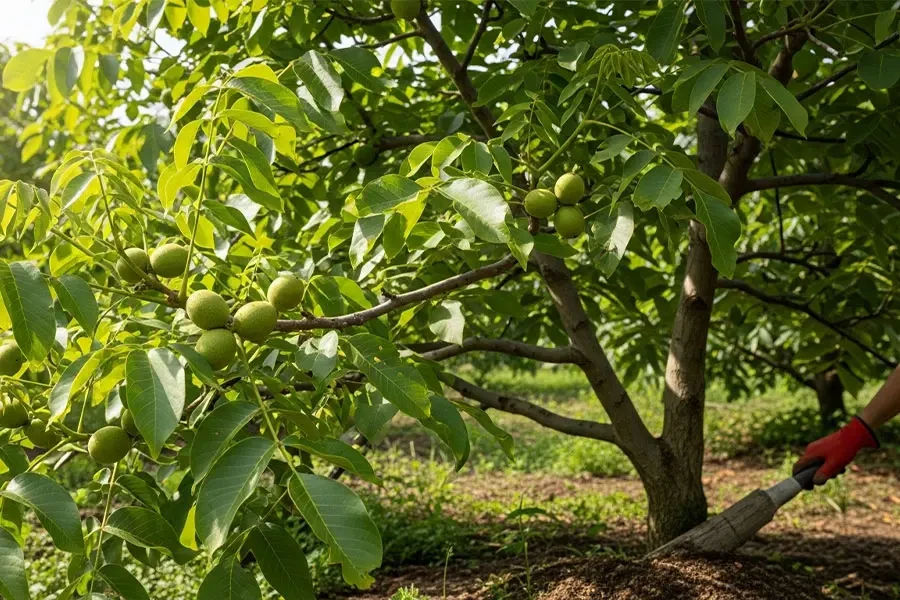
Walnut trees are among the most valuable but late-bearing fruit trees. To achieve high productivity, they require precise nutritional management. Fertilization is one of the most important steps in the walnut care program, because deficiencies or improper application of nutrients can disrupt tree growth, bud formation, and even kernel filling.
In this article from Asia Potash Industry Agricultural Journal, we explore walnut fertilization and its details. If you are interested in learning more about this valuable tree and its fertilization, do not miss this article.
Why is fertilization important for walnut trees?
Walnut trees have deep root systems and grow best in semi-heavy soils with proper drainage; however, even in fertile soils, the need for regular fertilization appears after several years.
Proper nutrition increases photosynthesis, root development, branch strength, and resistance to environmental stress. Without a proper fertilization program, walnut trees suffer from general weakness, leaf drop, and hollow kernels. Therefore, fertilization recommendations must be adjusted based on soil type, tree age, yield level, and climate conditions.
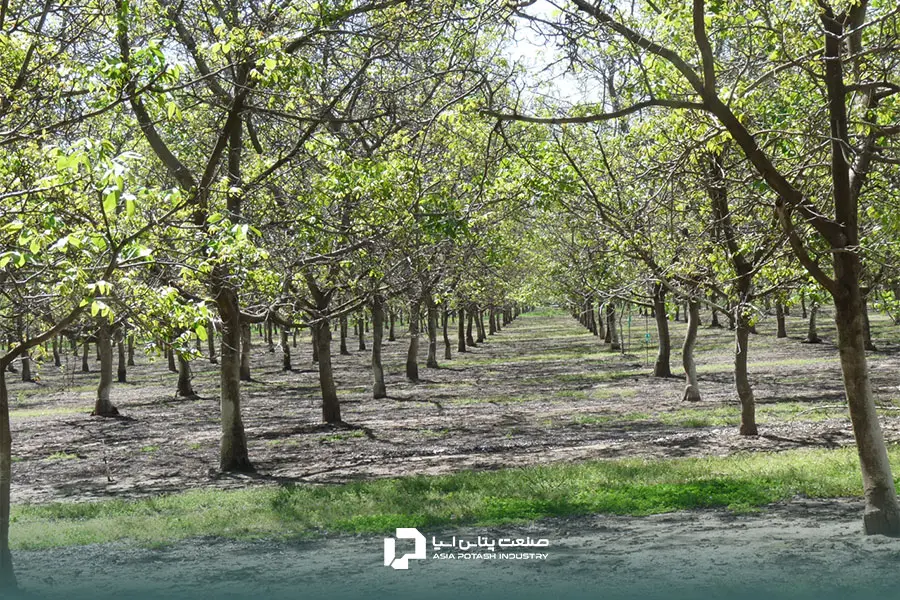
Nutrient elements required for walnut trees
For proper nutrition of walnut trees, identifying key nutrients is essential. Each of these elements plays a specific role in growth, flowering, fruit formation, and improving resistance to environmental stress. These nutrients must be supplied carefully and at the right time, because deficiency or excess of any element can reduce yield or weaken the tree.
Generally, nutrients for walnut fertilization are divided into two categories:
- Macronutrients that are required in large amounts and play structural roles in plant tissues.
- Micronutrients that are needed in small quantities but are essential for enzymatic and biological reactions.
Understanding the importance of each element is the foundation of a walnut fertilization program. If even one key nutrient is unavailable, tree growth is impaired and yield decreases significantly. Therefore, before implementing any fertilization program, soil and leaf analysis should be performed to ensure targeted and cost-effective fertilization.
Macronutrients required for walnut trees
- Nitrogen (N): Essential for vegetative growth, leaf formation, and new shoots; deficiency causes yellowing and reduced growth.
- Phosphorus (P): Supports root development, bud formation, and kernel maturation.
- Potassium (K): Key element for stress resistance, kernel quality improvement, and increased oil content.
- Calcium (Ca): Improves kernel quality and shelf life. It strengthens cell structure and prevents kernel cracking and decay.
- Magnesium (Mg): Plays a role in photosynthesis and energy transfer, maintaining leaf greenness.
- Sulfur (S): Essential for protein synthesis and better nutrient absorption.
Micronutrients required for walnut trees
- Iron (Fe): Important for chlorophyll formation; deficiency causes yellowing of young leaves.
- Zinc (Zn): Essential for bud formation and uniform shoot growth; commonly deficient in calcareous soils.
- Manganese (Mn): Activates photosynthetic enzymes; deficiency causes interveinal chlorosis.
- Copper (Cu): Enhances disease resistance and improves kernel quality.
- Boron (B): Important for fruit formation and preventing kernel emptiness.
- Molybdenum (Mo): Supports nitrogen metabolism, especially in acidic soils.
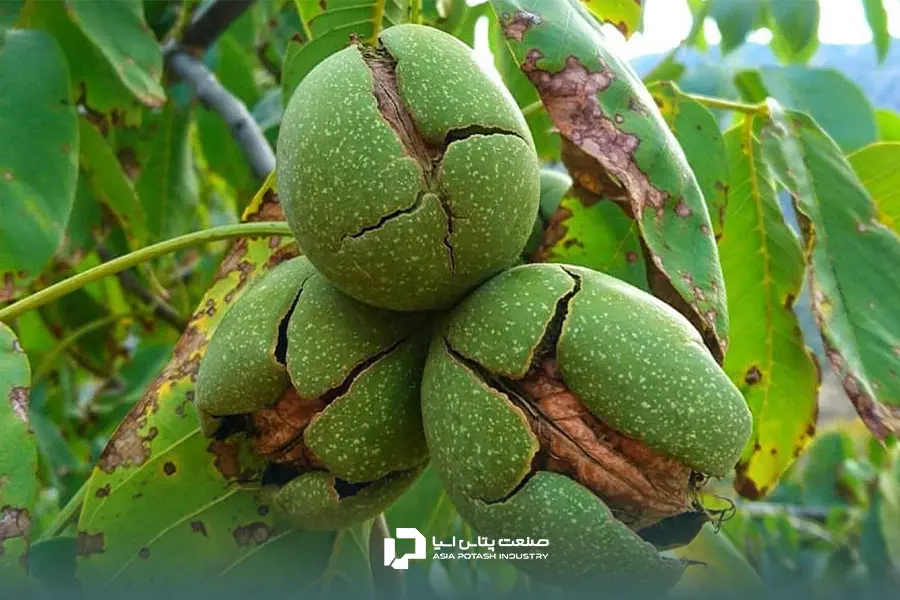
Best time for walnut fertilization
Walnut fertilization must be scheduled according to the annual growth cycle to maximize growth, yield, and fruit quality. Each season imposes specific nutritional needs on the tree. For example, in spring the tree requires nutrients for shoot and leaf growth, in summer for fruit development, and in autumn for energy storage and preparation for winter.
Fertilization methods also vary depending on the growth stage and nutritional goals.
Late winter fertilization (before bud break)
In late winter, before bud break, root fertilization with balanced fertilizers containing nitrogen, phosphorus, and potassium is recommended. Excess nitrogen at this stage may stimulate overly rapid growth and cause damage. Fully decomposed manure or poultry manure can also be used. Fresh manure should be avoided because of its high ammonia content, which can damage roots and increase weeds and pests.
Spring fertilization
In spring, trees enter vegetative growth and flowering. Nitrogen is essential during this stage. Nitrogen fertilizers such as urea or ammonium nitrate are recommended through soil application or foliar spray. Micronutrient sprays such as zinc and boron improve fruit set and reduce flower drop.
Summer fertilization
Summer is the best time for potassium application. During kernel filling, using soluble Potassium Sulfate increases kernel weight, improves taste, and enhances shelf life. In hot and dry regions, potassium fertilizers combined with drip irrigation are highly effective.
Autumn fertilization
After harvest, trees need strengthening for dormancy. Potassium and phosphorus fertilizers improve root systems and store nutrients for the next season. Adding decomposed manure at 30–40 cm soil depth is also beneficial.
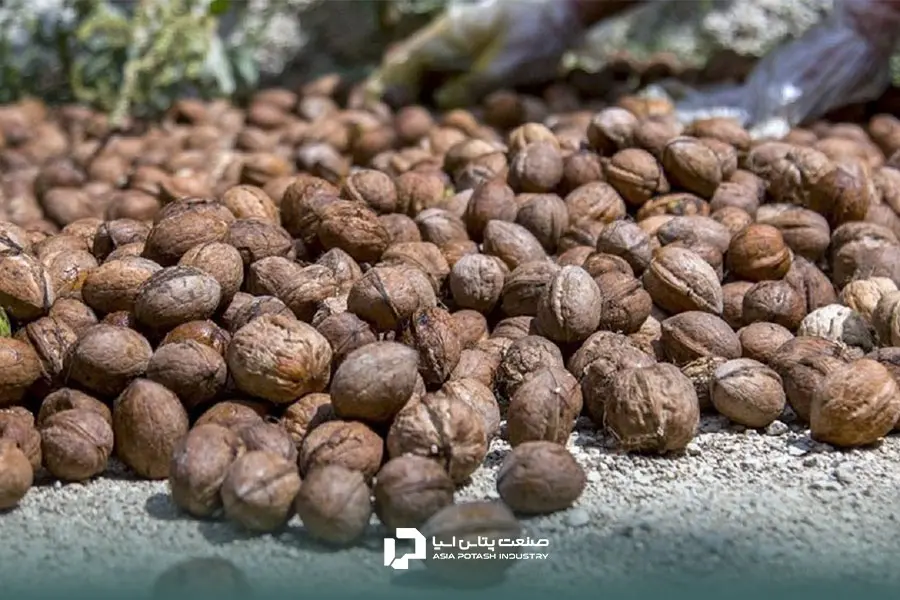
Walnut fertilization table (based on tree age)
A structured fertilization table helps farmers follow correct timing, fertilizer type, and dosage to avoid deficiency or overuse.
| Season | Fertilizer type | Application rate (per hectare) | Description |
| Spring (pre-flowering) | Nitrogen (N) | 30–50 kg | Provides energy for shoot and leaf growth |
| Spring (post-flowering) | Phosphorus (P₂O₅) | 20–30 kg | Supports root development and fruit formation |
| Summer | Potassium (K₂O) | 25–40 kg | Improves fruit size and stress resistance |
| Autumn | NPK compound | 50–70 kg | Stores energy and strengthens roots |
| Winter (as needed) | Micronutrients (Zn, B, Mn) | Based on soil test | Corrects deficiencies |
Note: Values are approximate and should be adjusted based on soil and leaf analysis.
Methods of walnut fertilization
Fertigation (fertilization through irrigation)
Water-soluble fertilizers such as Potassium Sulfate, urea, or potassium nitrate are injected into irrigation systems for efficient nutrient uptake.
Furrow application (trench fertilization)
Fertilizers are placed in holes around the tree canopy, especially in autumn or late winter, using organic and phosphorus-rich materials.
Foliar spraying
Micronutrients such as zinc, iron, and boron are sprayed directly onto leaves during growth stages for quick correction of deficiencies.
Key notes
- Always conduct soil and leaf analysis before fertilization.
- Young trees require more nitrogen; mature trees need more potassium.
- Avoid excessive nitrogen in summer.
- Use potassium fertilizers in dry regions to improve drought resistance.
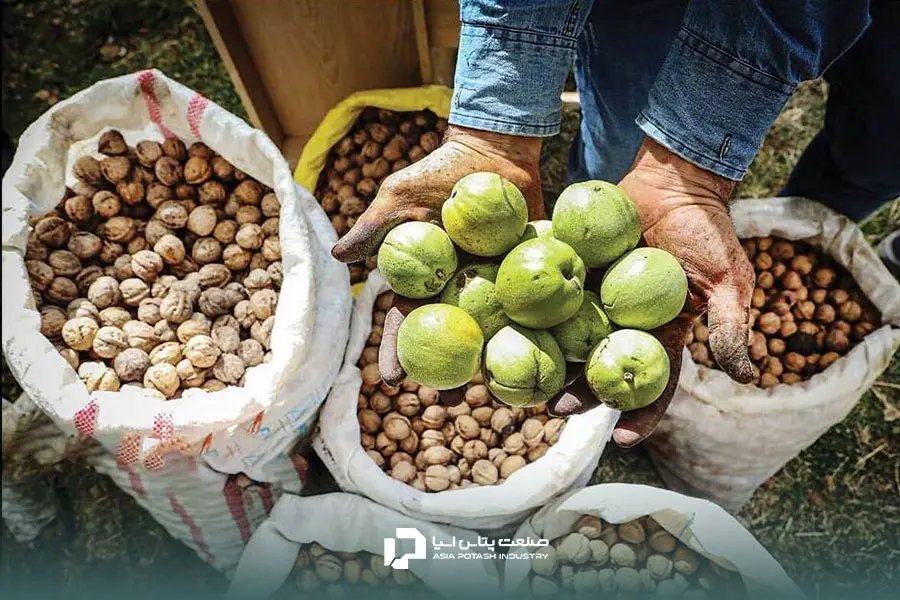
Improving walnut quality and yield with Asia Potash Industry
Asia Potash Industry, as a leading supplier of agricultural inputs, provides high-purity and fully soluble Potassium Sulfate fertilizer for walnut nutrition. Its use during kernel filling and after harvest improves kernel quality, increases fruit weight, and extends shelf life.
Conclusion
Walnut fertilization is a scientific and sensitive process that must be based on actual tree needs and soil conditions. Proper fertilizer selection and timing significantly improve yield and quality.
When farmers rely on soil testing, nutrient monitoring, and expert guidance, walnut trees achieve higher productivity with lower environmental stress.
Scientific fertilization, along with irrigation and pruning, forms the foundation of successful and sustainable walnut production.
Comments (0)
Be the first to comment!