
Saffron, this precious red gold, is not only a strategic product for Iran, but also the livelihood of thousands of hardworking farmers depends on its performance. However, the constant question is: how can we utilize the full potential of a saffron field and achieve maximum yield?
The scientific and proven answer lies in one word: proper fertilization!
A saffron fertilization program that is smart and based on scientific principles can increase your farm’s performance by 2 to 3 times. In this comprehensive guide from the Asia Potash Industry Agricultural Magazine, we provide step-by-step training on saffron fertilization stages, the best fertilizer for saffron, and a saffron fertilization schedule so that with the right investment, you can witness a significant increase in both yield quality and quantity.
Why is saffron fertilization important?
Many farmers consider scientific fertilization a cost, while in reality it is a highly profitable double investment. With a correct fertilization program, you simultaneously target two goals:
-
Current year’s yield: Increasing the number of flowers, dry stigma weight, and improving its quality (color, aroma, and taste).
-
Next year’s yield: This is the most important long-term benefit. Fertilizing saffron bulbs strengthens, enlarges, and multiplies daughter corms, which are the main capital of your farm for future years.
Neglecting scientific nutrition gradually leads to weakened corms, reduced flowering, and a severe drop in farm productivity.

Key nutrients for increasing saffron flowering
To understand saffron fertilization, we must first become familiar with its nutritional needs.
1. Macronutrients
-
Nitrogen (N): The main element responsible for leaf growth. Healthy and strong leaves mean more photosynthesis and therefore better nutrition for daughter corms.
-
Phosphorus (P): A key element for root development and energy transfer processes. It directly contributes to corm multiplication and weight gain.
-
Potassium (K): The most important element for saffron flower quality and quantity. Potassium acts as a regulator, increasing plant resistance to cold, heat, and diseases, increasing the number of flowers per plant, improving stigma weight and size, and enhancing saffron quality, color (crocin), and aroma (safranal).
Given the important role of potassium, using a high-quality and absorbable source is essential to achieve maximum flowering. Potassium Sulfate fertilizer, due to its high purity, excellent solubility, and sulfur content (another essential element), is known as the best fertilizer for increasing saffron flowering. For information about Asia Potash Industry Potassium Sulfate distributors, contact our experts.
2. Micronutrients
Elements such as iron (Fe) and zinc (Zn) should not be underestimated. Iron is essential for chlorophyll production and leaf greenness, while zinc strengthens the plant’s immune system. A deficiency in these elements can reduce the effectiveness of even the best macronutrient fertilizers.
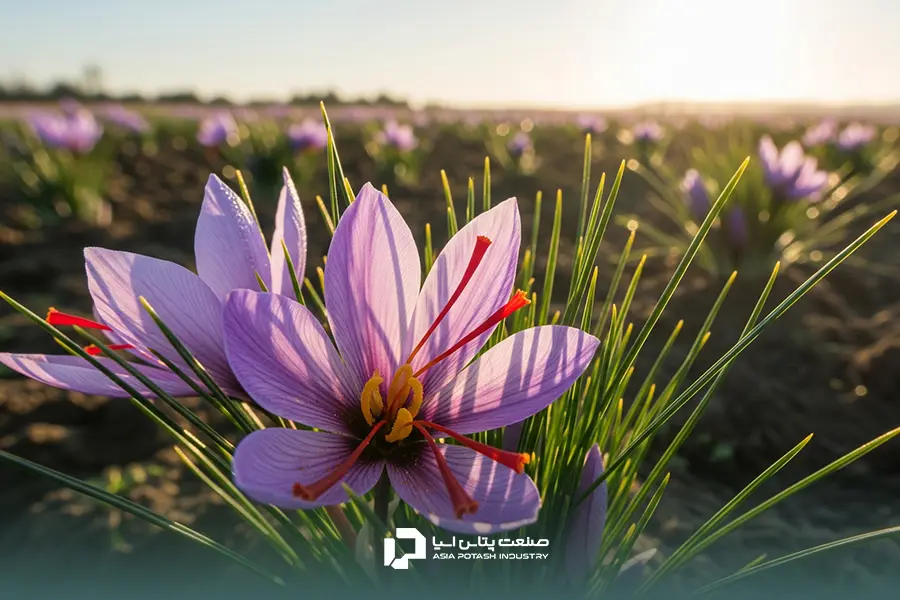
Saffron fertilization stages: when is the best time?
Timing is the key to success in saffron nutrition. Each growth stage of the plant has its own specific nutritional requirements.
1. Stage one: base fertilization (summer; before planting or rejuvenating old fields)
Field preparation is the foundation of the health and productivity of your saffron farm for at least 3 to 5 years, and any negligence in this phase—especially in improving soil structure and supplying immobile nutrients—will be difficult to compensate for during the production period.
The main goal at this stage is simultaneous improvement of the soil’s physical and chemical structure and long-term enrichment. This includes loosening the soil to improve permeability, reducing alkaline soil pH, and creating a stable nutrient reservoir with slow release.
At this stage, phosphorus (P), potassium (K), and sulfur (S) are key elements. Due to their low mobility in soil, if applied superficially they will never reach the root zone. Therefore, the only effective method is deep soil incorporation before planting. Well-decomposed manure also plays an important role in improving porosity and organic matter content.
Recommended fertilizers and application method:
-
Animal manure (fully decomposed and processed): Application of 40 to 80 tons per hectare is essential. It must be evenly distributed and deeply mixed with soil.
-
Phosphate fertilizers (such as triple superphosphate): The full recommended amount based on soil testing (usually 250–300 kg/ha) should be applied at this stage.
-
Potash fertilizers (such as granular Potassium Sulfate): About 250 kg/ha of potassium requirement is applied in this phase.
-
Bentonite sulfur: 400–450 kg/ha to gradually reduce soil pH and disinfect the soil.
2. First irrigation
This stage, initiated by the first irrigation of the season, awakens saffron corms from summer dormancy. The main focus here is stimulating high-quality flowering.
Potassium (K) is the most important element in this stage. Along with phosphorus (P) and humic acid, it plays a key role in nutrient uptake and flower development.
Recommended fertilizers and method
-
High potassium fertilizers (liquid Potassium Sulfate or Sulfopotash): 20–25 kg/ha via fertigation.
-
High phosphorus fertilizers (such as 10-52-10): 10 kg/ha with irrigation.
-
Liquid humic acid: 10–20 liters/ha to improve nutrient uptake.
Scientific recommendation: Some experts suggest the first irrigation should be done without fertilizer to avoid osmotic shock, depending on soil test results and corm strength.
Asia Potash Industry; the largest producer of Potassium Sulfate fertilizer in Iran
3. Second irrigation (post-harvest)
This is the most critical stage for ensuring next year’s yield. The plant must focus on vegetative growth (leaves), which act as food factories for daughter corm development.
Recommended fertilizers and method
-
Nitrogen fertilizers (urea): The only stage where urea is recommended. 50–100 kg/ha with irrigation.
-
Balanced NPK fertilizer (20-20-20): 10–15 kg/ha via fertigation.
-
Iron fertilizer (EDDHA chelate): 2–3 kg/ha to prevent leaf yellowing.
-
Seaweed extract: 3–5 liters/ha as a growth stimulant and stress reducer.
4. Winter foliar spraying
From mid-winter onward, foliar feeding becomes the most effective method due to reduced root absorption. The goal is to supply nutrients directly to daughter corms and improve stress resistance.
-
First spray (early January): amino acids (2 L/ha), seaweed extract (2 L/ha), micronutrient mix (1 kg/ha).
-
Second spray (late January): high phosphorus fertilizer (10-52-10, 3 kg/ha) + amino acids.
-
Third & fourth sprays (Feb–Mar): high potassium fertilizer (12-12-36) + micronutrient mix (Fe, Zn, Mn).
5. Spring irrigation (yellowing stage)
This irrigation, if needed, is the final opportunity to support the plant and ensure full nutrient transfer from leaves to corms. No nitrogen fertilizer is recommended at this stage.

What is the best fertilizer for saffron?
The best fertilizer for saffron is not a single product, but an integrated management program:
-
Organic fertilizers: Fully decomposed manure is the best for long-term soil improvement.
-
Chemical fertilizers: NPK formulations such as 10-52-10, 12-12-36, and Potassium Sulfate are essential tools for precise nutrition management.
-
Bio-stimulants: humic acid and seaweed extract improve uptake and stress tolerance.
Saffron fertilization schedule table
A complete annual program is provided below (per hectare):
| Stage | Time | Main goal | Application method | Recommended fertilizer |
| Base fertilization | Summer (pre-planting) | Soil improvement and long-term nutrient storage | Soil incorporation | 40 t manure + 250 kg superphosphate + 250 kg Potassium Sulfate |
| First irrigation | Autumn (Oct/Nov) | Increase flowering and stigma quality | Fertigation | 25 kg Sulfopotash + 10 kg 10-52-10 + 15 L humic acid |
| Second irrigation | December | Strengthen corms for next year | Fertigation | 15 kg 20-20-20 + 10 kg 10-52-10 + 50 kg urea + 3 kg iron fertilizer |
| First foliar spray | January | Stress resistance and general growth | Foliar spray | Amino acids + seaweed extract + micronutrients |
| Second foliar spray | Late January | Corm multiplication | Foliar spray | High phosphorus (10-52-10) + amino acids |
| Third foliar spray | Feb/March | Corm filling and weight gain | Foliar spray | High potassium (12-12-36) + Fe, Zn mix |
Asia Potash Industry: your partner in increasing saffron yield
Asia Potash Industry understands the challenges of saffron farmers and provides high-quality fertilizers to maximize farm potential. Scientific nutrition is the key to sustainable agriculture.
Potassium Sulfate from Asia Potash Industry is specially formulated to supply essential potassium during critical growth stages, ensuring larger, heavier, and higher-quality stigmas.

Final words
Saffron fertilization is a precise science, not a random practice. By following a scientific, stage-based program and using the right fertilizers at the right time, you can maximize both current and future yields. Remember: your most valuable asset lies underground—healthy and large corms that determine future production.
Was this guide helpful? Share it with other farmers. If you have questions or experience in saffron fertilization, feel free to leave a comment. Our experts are ready to help.
FAQ on saffron fertilization
High-potassium fertilizers such as Potassium Sulfate are the best choice for increasing flower number and weight.
Key times include: base fertilization (summer), first irrigation (autumn), post-harvest fertilization (winter), and foliar spraying (winter months).
A balanced NPK program (20-20-20), limited urea, phosphorus fertilizers, and iron are recommended.
Through fertigation (root feeding) and foliar spraying (leaf feeding).
No. Overuse of urea leads to excessive leaf growth and weak corm development, increasing disease and frost susceptibility.
Comments (0)
Be the first to comment!