Cotton fertilization must be carried out in a principled manner and with a precise program to produce a high-quality, marketable product. In this article from Asia Potash Industry Scientific Magazine, we examine the correct principles of cotton fertilization and provide a cotton fertilizer nutrition schedule to help you achieve a high-yield product that meets market demand.
1. Pre-planting fertilization; soil improvement with compost
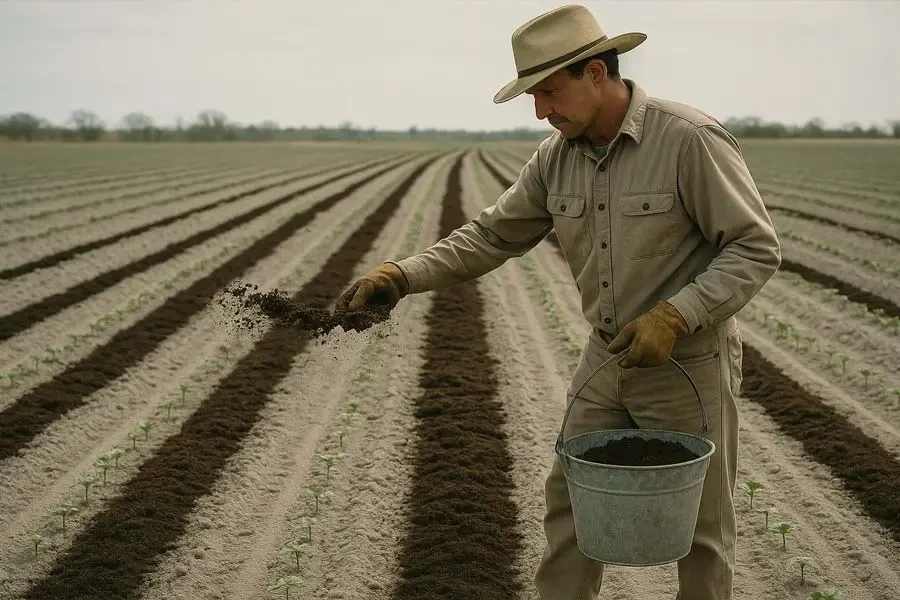
The use of well-decomposed manure or compost before planting cotton helps improve soil structure and increase organic matter. This action enhances the soil’s water and nutrient retention capacity. Components in compost such as nitrogen, phosphorus, potassium, and calcium are essential for root development and strengthening the plant’s defense system.
Proper use of well-decomposed manure or compost in cotton fertilization
In the pre-planting stage of cotton, the correct use of well-decomposed manure or compost plays an important role in soil preparation and strengthening the plant’s initial nutrition. To achieve maximum efficiency, attention to the following points is essential:
-
Uniform distribution: Compost or manure should be evenly spread over the field surface. This is usually done in late winter or early spring.
-
Soil incorporation: After spreading, it is better to incorporate the fertilizer into a depth of 10 to 20 cm using light tillage tools such as a disk harrow so that nutrients become available in the root zone.
-
Irrigation after fertilization: After applying fertilizer, light irrigation helps improve the penetration of organic matter and its more effective absorption.
-
Correct dosage: The application rate should be determined based on soil test results, soil texture type, and existing organic matter levels. Generally, 20 to 40 tons per hectare is recommended.
-
Following these points in the cotton nutrition program improves soil fertility, increases water-holding capacity, stimulates root growth, and ultimately enhances crop quality and yield.

2. Urea fertilization; nitrogen supply during different growth stages
Nitrogen is one of the key elements in cotton growth. The application of urea at different growth stages, especially during flowering and boll formation, increases yield and fiber quality. By applying urea in two main growth stages, nitrogen loss can be minimized.
3. High-phosphorus fertilization before flowering; improving flowering and fruit formation
The use of fertilizers with a high phosphorus ratio before the flowering stage helps strengthen the root system and transfer energy to flowers. This increases the number and quality of bolls.
4. Fertilization with calcium, boron, and zinc; preventing flower drop
To prevent flower shedding in cotton, the use of fertilizers containing calcium, boron, and zinc is recommended. These elements strengthen cell walls and flower structure and prevent premature flower drop.
5. Potassium Sulfate fertilization; improving fiber quality
Potassium Sulfate, by supplying potassium and sulfur, helps improve cotton fiber quality. The use of this fertilizer is recommended during mid-growth stages, especially during boll formation.
6. Precise fertilization timing; the key to success
Proper timing of fertilizer application at different cotton growth stages is very important. Soil analysis and consultation with agricultural experts can help determine the appropriate timing and amount of fertilization.
Complete cotton nutrition program table
In this section, you can become familiar with the cotton fertilizer program table to achieve a high-quality and marketable product.
|
Growth stage |
Type of fertilizer |
Application time |
Application rate (kg per hectare) |
|
Pre-planting |
Compost |
Autumn or early spring |
50–100 |
|
Germination and early growth |
Urea |
2–3 weeks after planting |
30–50 |
|
Flowering |
10-52-10 |
2–3 weeks before flowering |
40–60 |
|
Fruit (boll) formation |
Potassium Sulfate |
Mid-summer |
50–70 |
|
Prevention of flower drop |
Calcium + Boron + Zinc |
During flowering |
20–30 |
Key points in cotton fertilization
-
Soil analysis before starting fertilization: Conducting a soil test is the first and most important step in planning cotton nutrition. This analysis helps identify the actual needs of the plant in each region and prevents excessive or inefficient fertilizer use.
-
Use of organic fertilizers to improve soil: Using organic fertilizers such as compost and well-decomposed manure helps improve soil physical structure, increase water-holding capacity, and enrich soil organic matter. This provides a foundation for long-term sustainable cotton growth.
-
Determining fertilizer timing and dosage based on regional conditions: The exact timing and amount of fertilizer application should be adjusted based on the plant growth stage, soil type, climate conditions, and soil test results. Generally, cotton requires more nutrients during germination, flowering, and boll formation stages; however, the final program should be developed in consultation with agricultural experts and tailored to specific farm conditions.
-
Factors affecting precise fertilization planning: It should be noted that the exact amount and timing of fertilizer application may vary depending on soil type, weather conditions, and plant nutritional needs.
High-quality fertilizer and production of marketable, high-grade cotton
If you are looking for globally high-quality products to increase productivity in agriculture, drilling, chemical industries, or steel production, join Asia Potash Industry now.
Asia Potash Industry is with you to meet your specialized needs with the supply of Potassium Sulfate fertilizer, calcium chloride solution, Hydrochloric Acid, and Granular Calcium Chloride, providing professional-grade standards at competitive prices.
By purchasing directly from the largest Potassium Sulfate producer in Iran, you save on costs and benefit from guaranteed quality. To place an order or receive expert consultation, contact us now or visit the official website of Asia Potash Industry.
Improving cotton yield and quality with a proper fertilization program
Precise planning in cotton fertilization, using appropriate fertilizers at specific times, can improve crop yield and quality.
The use of organic fertilizers such as compost in early growth stages and mineral fertilizers such as urea, high-phosphorus fertilizers, calcium, boron, zinc, and Potassium Sulfate in later stages helps meet the plant’s nutritional needs and increase productivity.
Furthermore, consulting agricultural experts and conducting soil analysis can help determine the plant’s exact needs and support proper fertilization planning.
Comments (0)
Be the first to comment!