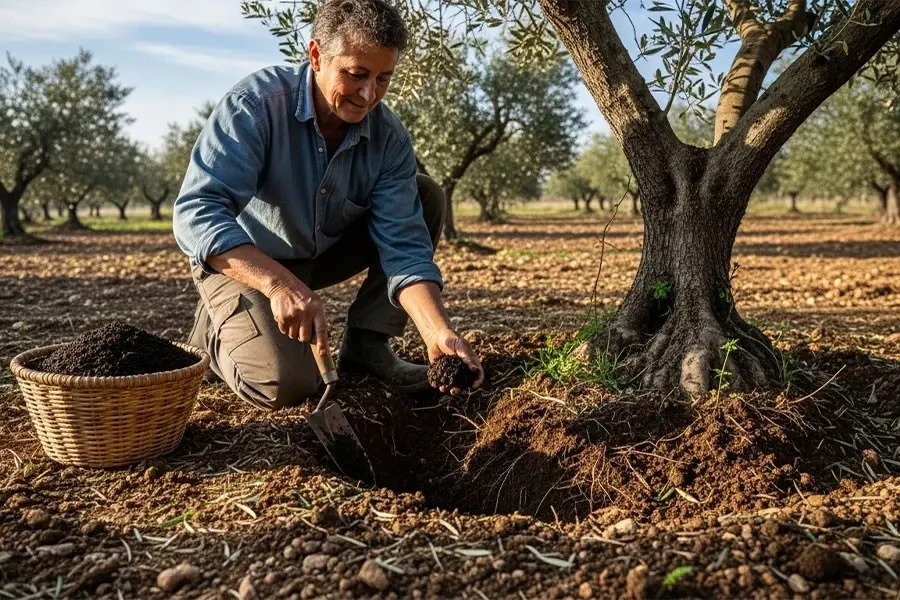
The olive tree, in order to produce a productive and high-quality crop, requires proper care and nutrition. Correct fertilization is considered one of the main pillars of olive orchard management, directly affecting tree health, oil yield, and resistance to environmental stress. The main question most growers ask is: what is the best fertilizer for olive trees Code and how should it be applied?
This question cannot be answered with a single fixed formula. You must understand the nutritional requirements of the olive tree and adapt them to soil conditions and the region’s climate. In this article from Asia Potash Industry Agriculture Magazine, we fully examine the types of suitable fertilizers for olive trees, precise timing, and how to implement an olive fertilization program.
First step in fertilizing olive trees: understanding the main required elements
Like any living organism, the olive tree requires a diverse range of nutrients for growth, productivity, and maintaining its health. These needs are generally divided into two categories: macronutrients and micronutrients. Understanding these elements and their roles is the first and most critical step in designing an olive fertilization program. Below, these key elements are reviewed.
Main elements (macronutrients): nitrogen, phosphorus, potassium
The main macronutrients are nitrogen, phosphorus, and potassium. These three elements form the foundation of olive tree nutrition and are typically included in NPK fertilizers. Their roles are as follows:
Nitrogen (N): growth stimulant
Nitrogen is responsible for vegetative growth, including branches and green foliage. It plays a direct role in protein and chlorophyll production. Nitrogen deficiency leads to yellowing of older leaves and growth stagnation. However, excessive use can cause excessive vegetative growth and reduce flowering and fruit set.
Phosphorus (P): root and fruit development enhancer
Phosphorus provides the energy required for many vital plant processes. It greatly contributes to the development of a strong root system, improved flowering, pollination, and fruit formation. Phosphorus deficiency often appears as purple-reddish leaves and flower and fruit drop.
Potassium (K): quality and resistance enhancer
Potassium, known as the “quality element,” plays a key role in sugar transport, protein synthesis, and cell osmotic regulation. It improves fruit size and quality, increases olive oil content, and enhances taste.
It also significantly increases the tree’s resistance to drought, cold, and diseases. Its deficiency typically appears as leaf margin burn in older leaves.
Secondary elements and micronutrients
While macronutrients are essential for growth, micronutrients also play a vital role in olive tree health and productivity. Deficiency of any of these elements can significantly reduce yield even when macronutrients are sufficient.
Calcium (Ca): cell wall strengthening element
Calcium helps strengthen cell walls and maintain membrane integrity. It plays an important role in fruit quality, storage life, and disease resistance. Calcium deficiency in olives can lead to soft fruit texture and reduced shelf life.
Magnesium (Mg): central element of chlorophyll
Magnesium forms the central part of the chlorophyll molecule and is essential for photosynthesis. Its deficiency usually appears as interveinal yellowing in older leaves.
Boron (B): key to pollination and fruit set
Boron is likely the most important micronutrient for olive trees. It directly affects pollination, pollen tube growth, and fruit formation. Boron deficiency is one of the main causes of irregular fruiting and flower drop in olive trees. It is involved in pollen tube growth and cell division, and its deficiency is associated with symptoms such as death of terminal buds, fruit cracking, and leaf deformation.
Zinc (Zn): growth and metabolism regulator
Zinc is an important micronutrient for plant growth and is involved in the production of growth hormones, especially auxins. It is essential for cell division and metabolism. Zinc deficiency causes small leaves that grow densely together, a condition known as “rosetting” or clustered shoot growth. 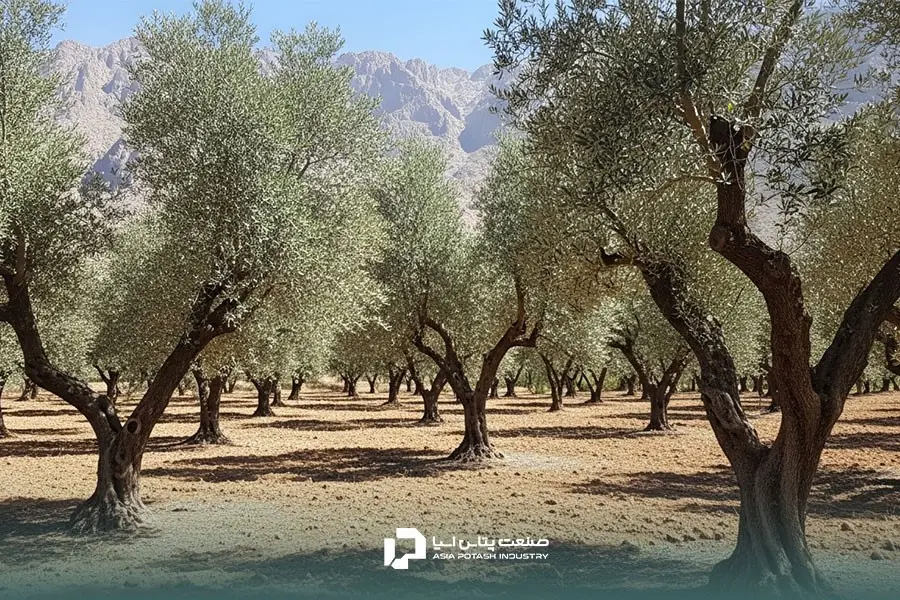
Best fertilizer for olive trees
In answer to the question “what is the best fertilizer for olive trees Code?”, there is no fixed formula. The choice of suitable fertilizers depends entirely on soil test results, leaf analysis, tree age, climate conditions, and growth stage.
An olive fertilization program should be a balanced combination of different fertilizers to fully meet the olive tree’s nutritional needs. Below are the most important fertilizers categorized by nutrient type:
Nitrogen fertilizers (vegetative growth boosters)
Nitrogen fertilizers are among the most important agents for vegetative growth in olive trees and help increase foliage and greenness.
Among them, ammonium sulfate is very suitable for alkaline soils due to its sulfur content.
Urea, with its high nitrogen content, is rapidly absorbed and acts quickly. In cool climates, ammonium nitrate is a good option as it provides nitrogen in a short time.
Phosphorus fertilizers (root and fruit development boosters)
These fertilizers are essential for root system development and fruit formation.
- Single superphosphate: the most common phosphorus fertilizer with good solubility.
- Monoammonium phosphate: contains both phosphorus and some nitrogen.
Potassium fertilizers (fruit quality and resistance)
Potassium fertilizers are essential for increasing fruit size, oil percentage, and tree resistance.
- Potassium sulfate: the best option for olive trees, as it also provides sulfur and contains very low chlorine.
- Potassium chloride: a cheaper option; however, its chlorine content can be harmful to olive trees in some soils.
Complete fertilizers (NPK)
These fertilizers contain all three elements nitrogen, phosphorus, and potassium in different ratios (such as 20-20-20 or 15-5-35). Their advantage is ease of use and providing a balanced basic nutrition.
However, their nutrient ratios may not fully match the specific needs of your olive orchard.
Organic and animal fertilizers (soil food)
These fertilizers not only supply nutrients gradually but also improve soil structure, increase permeability, and enhance beneficial microbial activity. They include decomposed manure, compost, and poultry manure. However, manure must be fully decomposed; otherwise, it may introduce weed seeds and pests.
Ultimately, the best fertilizer for olive trees is a combination that compensates for the soil deficiencies of your orchard.
Best time for olive tree fertilization
One of the secrets to successful olive fertilization, besides choosing the right fertilizer, is applying it at the correct time. Proper timing ensures that the tree receives nutrients exactly when it needs them most, maximizing fertilizer efficiency.
The olive fertilization season generally consists of three main stages:
Base fertilization (late winter or early spring)
This is the most important part of the annual fertilization program and aims to strengthen the tree for the upcoming growing season. It is typically done from late February to early March, when the tree wakes from dormancy.
The goal is to supply energy for new shoots, leaves, and flowering.
Supplementary fertilization (after fruit set)
This stage supports the tree during fruit growth and improves both yield and quality. It is usually carried out from June to July, right after fruit set.
The goals are increasing fruit size, improving oil content and quality, and reducing fruit drop.
Autumn fertilization
This is an optional but highly beneficial stage that prepares the tree for winter and the next season. It is performed from October to November and helps store energy in roots and branches for stronger spring growth. 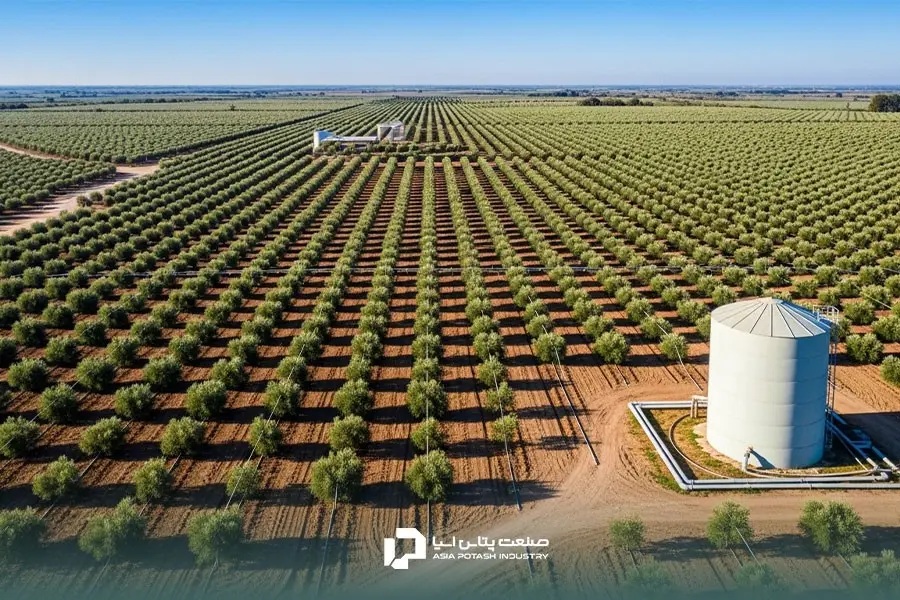
Olive fertilization program and table
In this section, a comprehensive olive fertilization program is presented in table form. This table is a general guideline; for precise planning, always rely on soil testing and leaf analysis results.
|
Tree growth stage |
Approximate time |
Type of fertilizer or recommended mix |
Application rate (mature tree) |
Application method |
|
Base fertilization (tree awakening) |
March to April |
Decomposed manure + single superphosphate + potassium sulfate + urea or ammonium sulfate |
20–40 kg manure / 0.5–1 kg superphosphate / 0.3–0.7 kg potassium sulfate / 0.2–0.5 kg nitrogen fertilizer |
Pit application or broadcasting in canopy zone + irrigation |
|
Pre-flowering fertilization |
May |
Foliar spray with zinc and boron chelates + calcium nitrate (soil application) |
According to product instructions |
Foliar spray and irrigation |
|
Fruit growth stage |
June to July |
Potassium sulfate + boron and zinc chelates |
0.2–0.4 kg potassium sulfate / according to label for chelates |
Surface application and foliar spray |
|
Summer foliar spray (heat period) |
August |
Amino acids + complete micronutrients (Fe, Zn, Mn, B) |
According to product label |
Evening foliar spray |
|
Post-harvest fertilization (autumn) |
October to November |
Potassium sulfate + single superphosphate + organic manure |
0.3–0.5 kg potassium sulfate / 0.3–0.5 kg phosphate / 20–30 kg organic manure |
Pit or surface application |
|
Winter fertilization (nutrient storage) |
December to January |
Compost + bentonite sulfur + phosphate-solubilizing microbial fertilizer |
Depending on soil conditions |
Mixed into soil around root zone |
For optimal use of this table, note the following:
- Values are general and depend on tree age, vigor, soil conditions, and cultivar.
- This fertilization table becomes optimal when adjusted based on soil and leaf analysis results. For example, if soil is rich in potassium, potassium sulfate usage should be reduced.
- Adjusting and managing soil pH plays an important role in nutrient absorption and tree health. Measuring soil pH helps optimize fertilizer selection and dosage.
- For better productivity, understanding agricultural fertilizers and correct fertilizer mixing is essential, as improper mixing can reduce nutrient uptake or damage roots.
How to apply fertilizer for olive trees: correct methods
Choosing the right fertilizer is only half of successful olive nutrition. Proper application methods are equally important for efficiency.
A proper fertilization program must include correct application techniques to ensure nutrients are effectively absorbed and not lost.
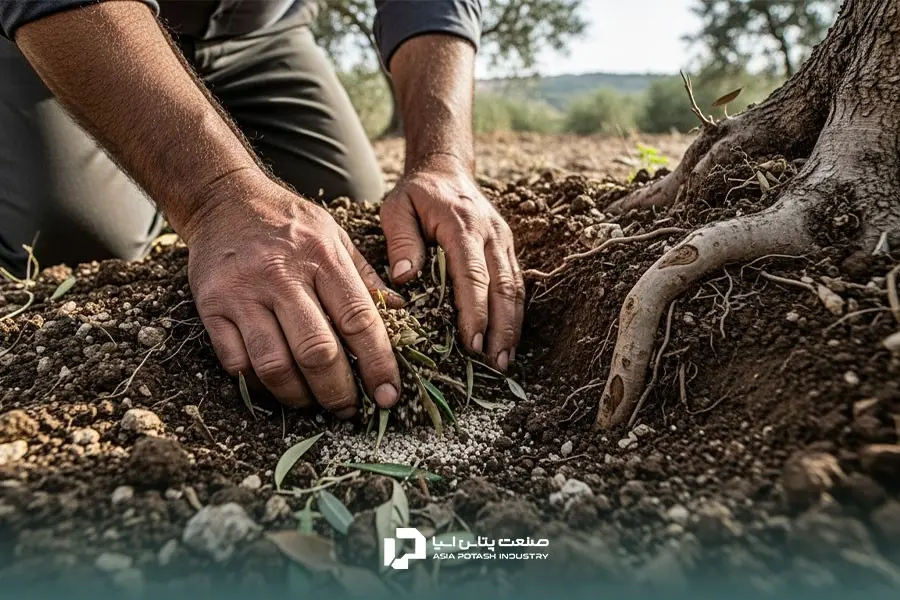
Trench (pit) fertilization method
This is one of the most effective methods for mature trees, especially for low-mobility nutrients like phosphorus and potassium.
In this method, 4–6 pits about 40–50 cm deep and 20–30 cm wide are dug in the canopy area. Fertilizers are mixed with soil and placed in these pits.
Advantages:
- Direct placement in active root zones
- Reduced nutrient loss in sandy or calcareous soils
- Improved water infiltration and soil aeration
- Encourages deeper root development
Broadcasting method
A simple and common method suitable for nitrogen fertilizers, which are more mobile in soil. Fertilizer is spread evenly under the canopy and then irrigated.
Advantages:
- Quick and easy
- No special equipment required
Foliar application
Fertilizer is dissolved in water and sprayed directly onto leaves. Micronutrients like zinc sulfate or boric acid are commonly applied this way, usually in cool hours (morning or evening).
Advantages:
- Fast absorption within hours
- Immediate correction of deficiencies
- Cost-effective for micronutrients
Fertigation (through irrigation)
A modern and efficient method used in drip or sprinkler irrigation systems, where fertilizers are injected into irrigation water and delivered directly to the root zone.
Advantages:
- High water and nutrient use efficiency
- Uniform distribution in root zone
- Precise control of dosage and timing
- Time and labor saving

Asia Potash Industry; an ideal choice for olive growers
As mentioned earlier, potassium can be considered the key quality element in olive cultivation. It plays a vital role in increasing fruit size, oil content, taste, and resistance to drought and cold.
Among potassium sources, potassium sulfate is considered the best option for sensitive olive trees due to its sulfur content and very low chloride level.
Asia Potash Industry is one of the leading suppliers of agricultural inputs, providing high-purity and highly soluble potassium sulfate to olive growers. Its use during fruit development ensures large, high-oil, and high-quality olives for both domestic and export markets.
Conclusion
Olive fertilization has three main pillars: understanding nutritional needs (NPK and micronutrients especially boron), selecting the right fertilizers (a combination of manure, potassium sulfate, and superphosphate), and following precise timing (spring base fertilization and post-fruit-set fertilization). Successful production of high-quality, high-oil olives depends on the simultaneous implementation of all three factors.
Comments (0)
Be the first to comment!