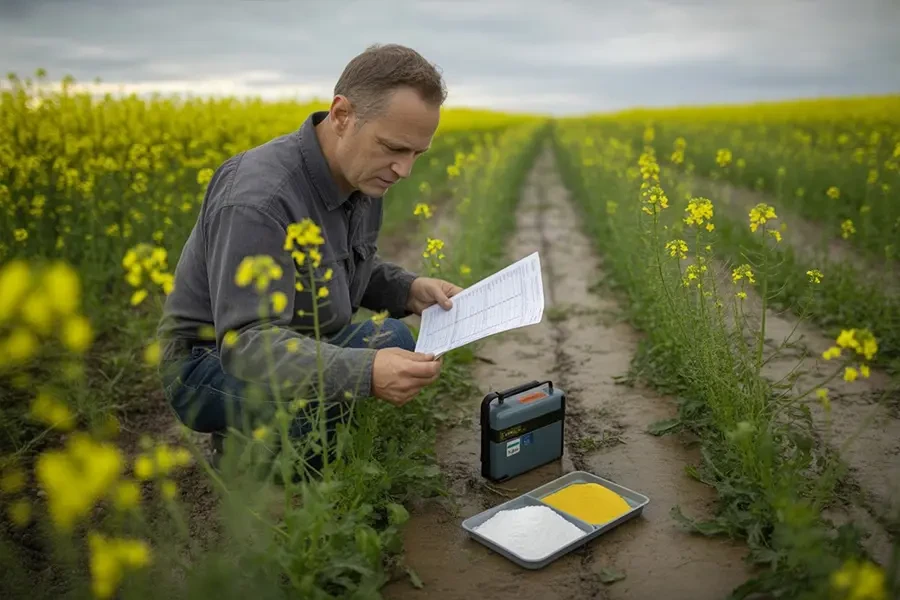
Rapeseed (canola) is one of the most important oilseed crops in Iran and worldwide. Rapeseed seeds contain 40 to 45 percent high-quality oil and 25 to 35 percent protein. For this reason, the crop is widely used for the production of edible oils and meal for livestock feed.
To achieve a high-quality rapeseed harvest, following a scientific and principled fertilization and nutrition program is essential. This requires a deep understanding of the plant’s physiological needs and their balance with the growing environment. This balance is achieved based on the nutritional requirements of rapeseed and the soil’s chemical and physical characteristics. Considering this subject, in this comprehensive guide from the Asia Potash Industry Agricultural Magazine, we aim to examine all these factors and provide a scientific approach for better and higher yields.
Nutrient elements required by rapeseed
Before moving to fertilization programs and the best fertilizers for rapeseed, it is important to understand the key nutrients required for optimal growth of this crop. These nutrients are divided into macronutrients and micronutrients.
Each of these two main nutrient groups is essential and critical for completing the growth cycle of rapeseed.
1. Macronutrients in rapeseed
Macronutrients are those absorbed by the plant in large quantities and are vital for metabolism and structure. They are divided into primary and secondary elements.
Primary macronutrients
-
Nitrogen: Nitrogen has the greatest impact on vegetative growth and yield of rapeseed. Adequate supply increases plant height, number of lateral branches, leaf area, flowering duration, and ultimately pod formation and seed yield.
-
Phosphorus: Phosphorus plays a key role in early growth stages, root development, and energy supply for metabolic processes in rapeseed.
-
Potassium: Potassium is known in agricultural science as the element of quality and resistance. It improves water balance in the plant, increasing tolerance to drought and cold stress. It also activates more than 60 enzymes in rapeseed, resulting in increased seed weight, oil and protein content, and stronger stems.
Secondary macronutrients
-
Sulfur: Rapeseed requires 3 to 4 times more sulfur than other cereals. Sulfur is a structural component of essential amino acids for protein formation in seeds, playing a key role in final yield quality. It also helps reduce soil pH and improve soil conditions.
-
Calcium: Calcium is a secondary macronutrient essential for cell wall structure stability and proper root and shoot development.
-
Magnesium: Magnesium is the central atom in the chlorophyll molecule of rapeseed and is therefore critical for photosynthesis and plant productivity.
2. Micronutrients in rapeseed
Micronutrients are required in very small amounts but act as essential catalysts in enzymatic processes, photosynthesis, and reproduction. Without them, key physiological processes are disrupted, and plant growth suffers severely.
-
Iron: Essential for chlorophyll formation and activation of respiratory and photosynthetic enzymes; deficiency causes yellowing of young leaves.
-
Zinc: Involved in growth hormone production and prevents dwarfing and small leaf development.
-
Manganese: Essential for photosynthesis and nitrogen metabolism; deficiency causes interveinal chlorosis.
-
Boron: Necessary for pollen germination, successful fertilization, and seed formation; prevents empty pods.
-
Copper: Required for enzyme activation, stem strength, and respiratory and photosynthetic processes.
-
Molybdenum: Essential for converting nitrate into protein in plants and improves efficient use of nitrogen fertilizers.

Important note: To implement a proper rapeseed fertilization program, knowing the available nutrient levels in the soil is essential. The best way to achieve this is through soil testing.
This test not only determines nutrient levels but also provides clear information about the soil’s chemical and physical status such as pH and salinity. Based on these results, you can design a scientific fertilization program specifying which nutrients are needed and in what quantities.
Structural factors affecting nutrient uptake in rapeseed fertilization
As mentioned above, in addition to understanding nutrients, knowing soil structural conditions is also important. These factors can be analyzed from three perspectives:
1. Soil pH effect
Soil pH or acidity is a key variable that affects nutrient availability. Most nutrients required by rapeseed are absorbed best in neutral pH range (6 to 7.5). Since many soils in Iran are calcareous and alkaline, nutrient uptake is often limited, leading to reduced crop performance.
To address this issue, different solutions exist. One is using acidifying fertilizers, such as agricultural sulfur.
Chelated forms of micronutrients can also be used, and foliar spraying helps bypass soil limitations and directly supply nutrients through leaves.
2. Soil and water salinity
High salinity is another environmental stress that directly affects plant nutrition in arid and semi-arid regions. It reduces the plant’s ability to absorb water, a condition known as physiological drought.
Although rapeseed is relatively salt-tolerant, even this crop suffers at high salinity levels (above 10 dS/m), leading to reduced water uptake and lower yield.
To improve conditions, calcium-containing fertilizers (to replace harmful sodium on soil colloids) and organic materials such as humic acid are recommended to improve soil structure and reduce salinity effects.
3. Winter or spring rapeseed cultivation
Fertilization strategies differ significantly between winter and spring rapeseed due to exposure to cold stress.
Winter rapeseed fertilization programs should strengthen plant resistance to cold. Therefore, base fertilization should include sufficient phosphorus and potassium to promote deep root development, increase cell sap concentration, and improve frost resistance. Nitrogen top-dressing should be applied in late winter or early spring.
In contrast, spring rapeseed requires a more intensive and fast fertilization program, where all nutrients must be supplied in a short period, and the gap between base and top-dressing applications is minimal.

Rapeseed fertilization program (from planting to harvest)
After the above information, we can move to a step-by-step fertilization program. This is a general guideline, and the best program should be adjusted based on soil test results. Let’s review it stage by stage from pre-planting to harvest.
1. Land preparation and base fertilization (pre-planting)
The goal of this stage is to prepare the soil for strong planting. Soil structure must be improved while supplying essential nutrients for early growth.
Recommended inputs:
- 20–40 tons of fully decomposed manure (preferably cattle manure) or 10–20 tons of poultry manure per hectare before autumn plowing.
- 100–150 kg phosphorus fertilizer (e.g., triple superphosphate) and 100–150 kg potassium fertilizer (e.g., potassium sulfate) per hectare, plus 100–200 kg granular sulfur per hectare.
2. Seed treatment stage
The goal is to improve germination speed and uniformity and enhance early seedling vigor. Seeds can be treated with growth stimulants such as seaweed extract (100 g per 200 kg seed) or humic acid combined with zinc sulfate solution.
3. Rosette stage (4–8 leaves)
The goal is root development, leaf expansion, and maximum photosynthesis. Fertilization is done via irrigation and foliar spraying:
- Fertigation: First nitrogen top-dressing (50–100 kg urea or ammonium sulfate per hectare) plus 5–10 liters humic acid per hectare.
- Foliar spray: NPK 20-20-20 (2–3 kg/ha) plus amino acids (0.5 kg/ha).
4. Stem elongation stage
The goal is rapid stem growth.
- Fertigation: Second nitrogen top-dressing (50–100 kg urea or ammonium sulfate per hectare) plus potassium chloride (50 kg/ha).
- Foliar spray: complete fertilizers with macro and micronutrients plus potassium silicate to improve stress resistance.
5. Pre-flowering and flowering stage
The goal is energy supply for flowering and pod formation.
Apply third nitrogen top-dressing (50 kg urea/ha) and liquid sulfur (8–10 L/ha). Foliar sprays with high-phosphorus fertilizers plus boron and zinc are also recommended.
6. Pod formation and seed filling stage
This is a critical stage determining final yield quality.
- Fertigation: potassium is the key element; potassium sulfate is recommended.
- Foliar spray: high-potassium liquid fertilizers and calcium-based products.
Complete rapeseed fertilization table
| Growth stage | Key goals | Application method | Recommended fertilizer | Dosage/Description |
Importance of potassium sulfate in rapeseed fertilization
Potassium sulfate supplies both potassium and sulfur simultaneously, making it an efficient and economical choice for rapeseed nutrition. It directly improves yield quantity, oil content, and stress resistance.
Asia Potash Industry is the largest producer of potassium sulfate in Iran. We are committed to high-quality production and supporting agricultural development. For more information about distribution representatives of high-potassium fertilizers, please contact our experts.
Final remarks
For achieving high-quality and high-yield rapeseed production, a scientific approach to plant nutrition is essential. This article emphasized three main pillars: understanding nutrient requirements through soil testing, balanced nutrient supply, and correct fertilizer selection and application methods.
If you still have questions about rapeseed fertilization, feel free to share them in the comments.
Comments (0)
Be the first to comment!