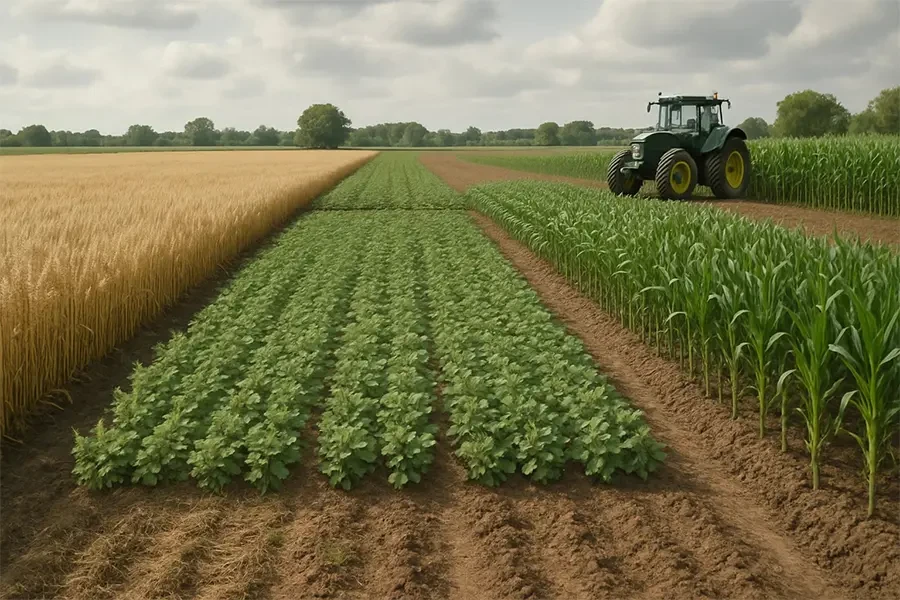
Crop rotation means that instead of planting the same crop in a fixed field every year, different crops are cultivated in a planned and periodic sequence, replacing one another over time.
This practice helps prevent soil nutrient depletion, improves soil quality, and reduces the spread of pests and diseases. By implementing this method, farmers can both increase land productivity and maintain soil health.
In this article, we will explore what crop rotation actually is and how its intelligent use can contribute to modern agriculture.
What is crop rotation?
To answer the important question “what is crop rotation,” we can say that crop rotation is a scientific and systematic agricultural method used to improve crop yield and quality.
In this method, instead of repeatedly planting a single crop in the same field, farmers systematically replace different crops at defined time intervals.
Crop rotation is carried out to control pests and diseases, improve soil quality, reduce dependence on chemical fertilizers and pesticides, and ultimately increase farm productivity.
Importance of crop rotation
To understand the importance of crop rotation, it is enough to look at traditional agriculture. Before chemical fertilizers and industrial pesticides became widely available, farmers maintained soil fertility through crop rotation.
Today, despite access to modern technologies, crop rotation remains one of the key methods for reducing costs, preserving natural resources, and ensuring long-term agricultural sustainability.
One of the major challenges in agriculture is maintaining stable and sustainable production. Sustainable agriculture ensures sufficient food production while using natural resources such as water and soil in a way that meets present needs without compromising future generations.
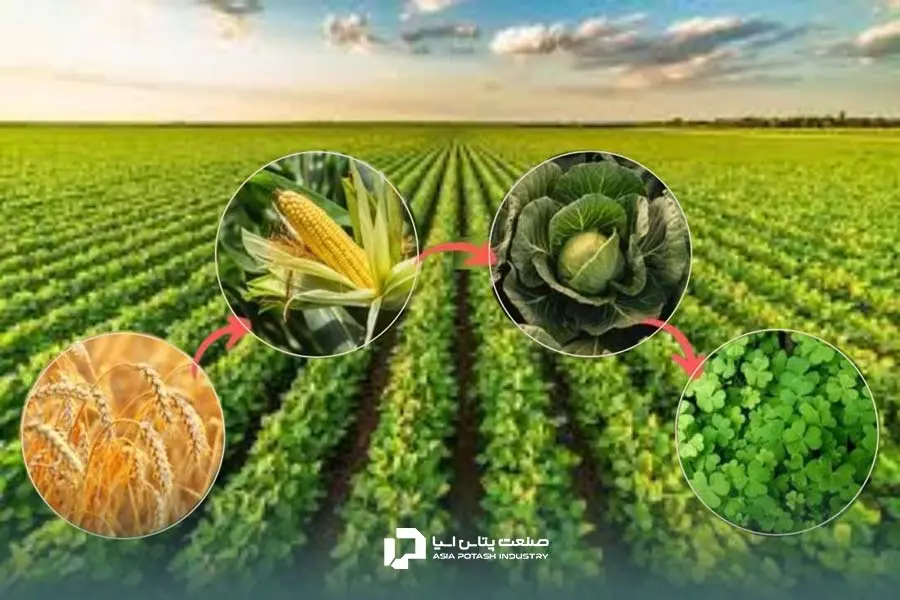
Advantages of crop rotation
Crop rotation offers a wide range of benefits that directly impact soil quality, plant health, and farm profitability. The most important advantages include:
1. Improving soil structure and fertility
Rotational cropping increases nitrogen in the soil through nitrogen-fixing plants such as peas and lentils. Additionally, deep-rooted plants extract minerals from deeper layers and make them available for subsequent crops.
For example, planting alfalfa in rotation improves soil structure, making it lighter and more friable. After plowing alfalfa, the soil becomes more balanced with better aggregation and increased resistance to erosion, while also increasing humus (valuable organic matter).
2. Increasing productivity
A well-designed crop rotation system improves overall yield. For instance, rotating corn and soybean can increase productivity compared to continuous monocropping.
Research shows that changing crop types can increase yields by 10 to 25 percent. This method ensures that the soil provides balanced nutrients for different crops and is recommended for low-yield fields.
3. Controlling plant diseases
When pathogens continuously find a suitable host in the soil, they multiply more easily. Crop rotation breaks this cycle, reducing disease spread and improving soil and plant health.
For example, soybean cyst nematode, a soil-dwelling pest that damages roots, can be reduced by rotating soybean with crops such as wheat and corn. Continuous monocropping, however, encourages pest buildup and soil degradation.
4. Managing pest populations
Some pests depend on specific crops. By changing crops each season, these pests lose their food source, reducing the need for chemical pesticides.
For example, corn rootworms overwinter in soil as larvae or eggs. Planting non-host crops after corn forces these pests to die off due to lack of food. However, some pests may adapt and persist even under rotation systems.
Asia Potash Industry; Largest Potassium Sulfate Producer in Iran
5. Natural weed control
Changing crop species alters competition conditions for weeds and reduces their growth. This is a sustainable alternative to chemical herbicides.
Weeds have always been a major problem for farmers. While chemical and mechanical control methods exist, excessive soil disturbance and chemical use can harm the environment. Crop rotation provides a more sustainable solution.
6. Increasing soil organic matter
Leftover plant residues from previous crops enrich the soil with organic matter, improving water retention and root nutrition.
Organic matter decomposes slowly, so crop rotation reduces the need for intensive tillage and improves biological, chemical, and structural soil properties.
7. Reducing soil erosion
Rotational cropping maintains soil cover and reduces erosion caused by wind and surface water runoff.
To maximize erosion control, crop rotation should be adapted to climate conditions. In stable climates, fixed rotations may be used, while in variable climates, flexible systems are more effective.
8. Increasing soil biodiversity
Crop rotation creates favorable conditions for beneficial microorganisms that play a key role in soil health.
Higher biodiversity supports a more balanced microbial community, improving nutrient cycling and supporting subsequent crops with different carbon-to-nitrogen requirements.
9. Reducing economic risk
In variable climatic conditions, crop diversity ensures more stable yield and income. Some crops may tolerate floods better, while others perform better under drought conditions.
Diversifying crops reduces financial risk and allows harvests to be distributed across different times of the year. It also improves labor efficiency and land utilization.
How crop rotation increases farm productivity
Crop rotation means planting different crops each year, allowing soil to recover and be used more efficiently.
As a result, reliance on chemical fertilizers and pesticides decreases, soil health improves, and crop yields increase.
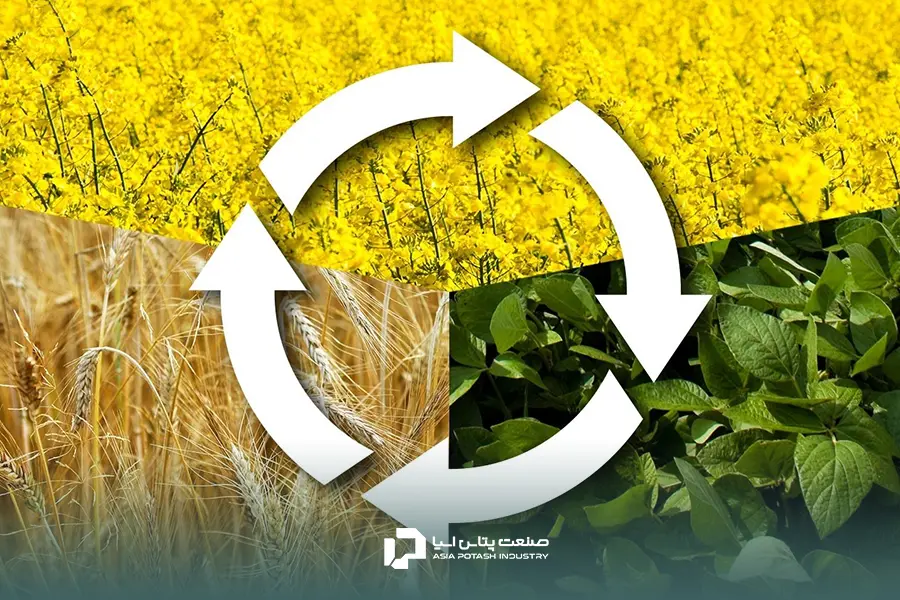
Increasing agricultural productivity with Asia Potash Industry specialty fertilizers
To fully benefit from crop rotation and improve both the quality and quantity of your crops, contact the experts at Asia Potash Industry. The company offers Potassium Sulfate and other specialized products to improve soil health and farm productivity.
Using modern technology and high-quality products is a key step toward sustainable and economic agriculture. Start working with us today to achieve the best results in your farm.
Conclusion: Crop rotation as a forward-looking approach in smart agriculture
In response to the question “what is crop rotation?”, it can be said that this method is both a technique and an intelligent approach to farming.
Crop rotation improves soil structure and quality, naturally controls pests and diseases, increases biodiversity, and reduces chemical usage.
This sustainable agricultural method not only preserves natural resources but also increases productivity and reduces economic risk for farmers. Proper implementation combined with modern fertilizers and technologies leads to optimal results.
Comments (0)
Be the first to comment!