
For increasing barley grain yield, the fertilization program must be designed based on several key factors. These include optimizing soil structure, maintaining a proper balance of essential nutrients, and precise timing of fertilizer applications. In the following, we will examine how to design a fertilization program using different data in this field, as well as the best fertilizer for increasing barley yield.
Factors Affecting the Barley Fertilization Program
The fertilization program for increasing barley grain yield should be based on several key principles:
1. Providing optimal conditions for plant growth through a proper balance of essential nutrients is crucial.
2. Improving soil structure and adding organic matter enhances nutrient uptake by the plant.
3. Specific regional needs, climate conditions, and soil type must be considered in designing the fertilization program.
4. Fertilization must be applied at the right time according to different growth stages of the plant.
5. Proper irrigation management and pest/disease control also significantly affect barley yield.
Pre-Planting Fertilization Program
Before planting barley, soil conditions must be optimized so the plant can achieve its best growth. This process begins with a soil test to determine pH, nitrogen, phosphorus, and other essential macro and micronutrients such as potassium. Based on these results, necessary amendments are made, including adjusting soil pH (6.0 to 7.5) and adding organic matter such as compost.
Organic granular fertilizers, which often include combinations of wheat straw and stubble, fruit peels, compost, and animal waste, are very effective in improving soil fertility and providing balanced nutrition for plants. These fertilizers release nutrients gradually and help reduce environmental pollution.

Seed Treatment of Barley
Seed treatment refers to coating barley seeds with nutrients before planting. This method improves germination strength and enhances root development. One suitable fertilizer for this stage is Multi Complex fertilizer.
This fertilizer contains nitrogen, potassium, phosphorus, copper, zinc, and manganese, all of which contribute to improved germination and plant growth. It is applied by dissolving it in water and spraying it onto the seeds, which increases germination speed and seedling establishment.
Fertilization During Tillering Stage
Tillering is the natural process of producing lateral shoots, which increases plant density and yield. In barley cultivation, tillers play an important role in boosting productivity, and favorable conditions are required for their development.
Fertilizers containing balanced phosphorus, nitrogen, and potassium should be used in this stage. High-phosphorus fertilizers are recommended, as phosphorus strengthens the root system and improves nutrient uptake.
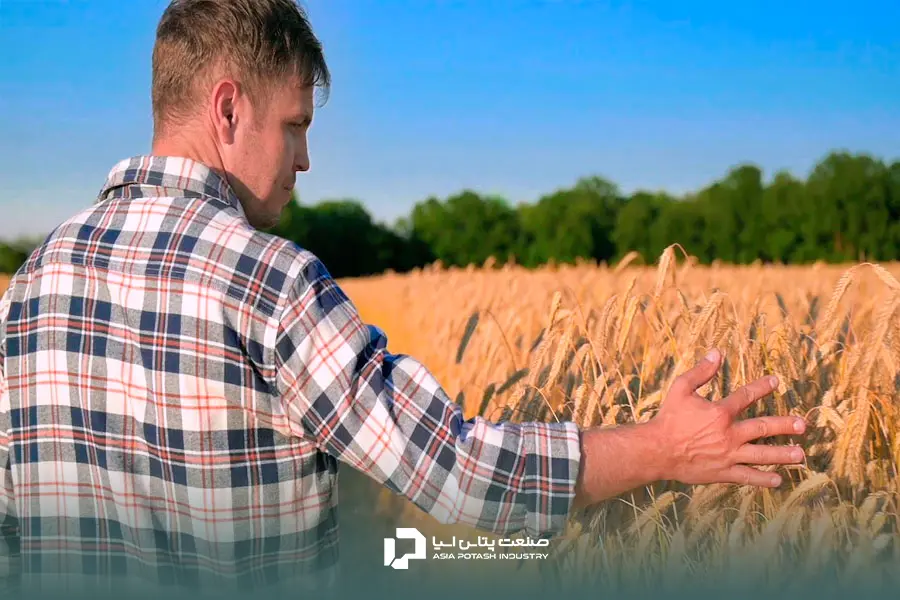
Fertilization During Heading Stage
The heading stage is a critical phase in barley growth where grains begin to form. At this stage, increased amounts of phosphorus and potassium are essential for better grain development and quality.
Potassium fertilizers such as Potassium Sulfate are essential at this stage, and potassium fertilizers combined with amino acids can also be used.
Nutrition During Grain Filling Stage
During the grain filling stage, barley has a high demand for nutrients to properly develop grains. Potassium fertilizers are highly recommended at this stage.
Potassium is essential for cellular activity, osmotic regulation, and increasing resistance to diseases. It also improves plant tolerance to environmental stresses and diseases.
Dryland Barley Nutrition
Dryland barley cultivation depends solely on natural rainfall and is carried out in arid and semi-arid regions with annual rainfall of about 300–500 mm. Therefore, fertilization differs from irrigated farming systems.
Barley is widely used in food production such as barley bread, breakfast cereals, malt-based beverages, and animal feed due to its high nutritional value. Proper fertilization is essential for achieving optimal yield and quality.
Nitrogen is essential for growth and development. Phosphorus is crucial for root development, flowering, and grain formation. Potassium strengthens plant structure and increases resistance to environmental stresses such as drought, salinity, pests, and diseases.
What is the Best Fertilizer for Increasing Barley Yield?
Potassium Sulfate is the best choice for increasing barley yield. In addition to supplying essential potassium, it also provides sulfur, improving grain quality and significantly increasing plant resistance to biotic and abiotic stresses.
This fertilizer is especially effective during critical growth stages such as grain filling and tillering, helping optimize yield and plant performance.
Potassium Sulfate Application Schedule for Irrigated Barley
The table below presents the recommended Potassium Sulfate application program for irrigated barley cultivation:
Important note: In dryland barley cultivation, due to the lack of irrigation, basal fertilizers such as Potassium Sulfate are usually applied before planting during soil preparation. In case of rainfall during the season, top-dressing or foliar application may be used.
|
Growth Stage |
Application Time |
Method of Potassium Sulfate Application |
|
Pre-Planting |
Before land preparation |
Soil application to improve fertility |
|
Germination |
After initial sprouting |
Not generally recommended; nitrogen and phosphorus are prioritized |
|
Tillering |
During shoot formation |
Irrigation fertilization to increase tiller density |
|
Stem Elongation |
Early stem growth |
Foliar or irrigation application to strengthen stems |
|
Heading |
Before head formation |
Foliar spraying to improve grain quality |
|
Grain Filling |
During grain development |
Irrigation fertilization to increase grain weight and quality |
Conclusion
To achieve higher barley yield, designing an effective fertilization program and following precise timing is essential. Considering soil needs, crop requirements, climatic conditions, and growth stages, Potassium Sulfate can be used as one of the best fertilizers for increasing barley yield.
Comments (0)
Be the first to comment!