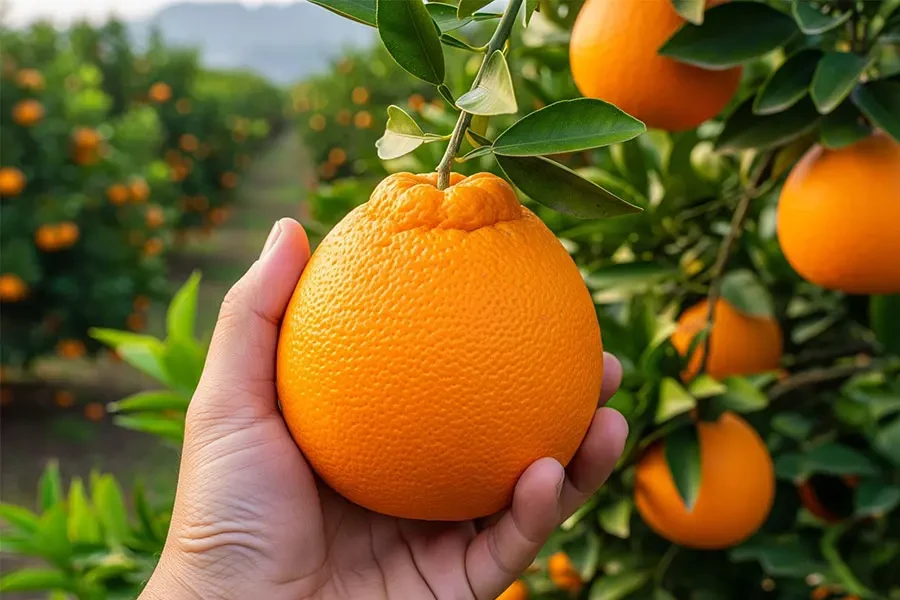
Citrus fruits, these juicy and flavorful fruits, are not only part of Iran’s agricultural capital but are also considered a strategic product with extensive export markets. However, achieving large, high-quality, well-colored fruits with high yield is not accidental. This success is the direct result of a scientific, precise, and well-timed citrus fertilization program. If you are looking for a significant increase in yield and fruit quality in your orchard, this comprehensive guide will serve as your roadmap.
In this article from Asia Potash Industry Agriculture Magazine, we show you how, by understanding the tree’s needs, identifying the best fertilizer for citrus, and implementing a precise nutrition program, you can turn your orchard into a successful and profitable model.
Why is scientific citrus fertilization a smart investment?
Ignoring proper nutrition is like expecting a harvest from land where nothing has been planted. Citrus trees require a wide range of nutrients for growth, flowering, and high-quality fruit production. A proper nutrition program directly leads to the following:
- Increased yield: Balanced nutrient supply maximizes the tree’s fruit production capacity.
- Improved fruit quality: Elements such as potassium directly influence fruit size, juiciness, taste (sugar content), and coloration.
- Increased tree resistance: Complete nutrition improves resistance against cold, heat, drought, pests, and diseases.
- Reduced alternate bearing: A structured fertilization program helps the tree rebuild its nutrient reserves and control alternate bearing (high yield one year, low yield the next).
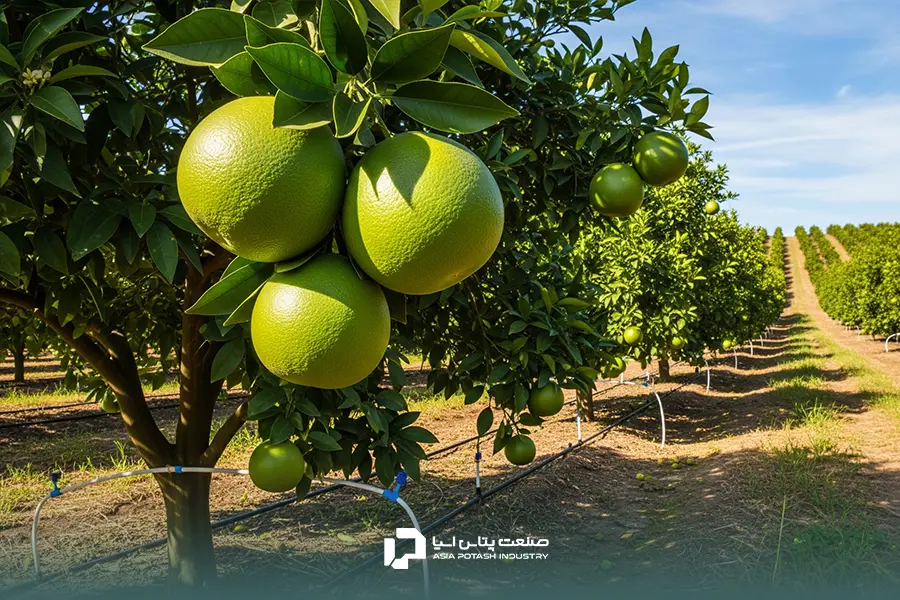
Which nutrients are essential for citrus trees?
Citrus trees require 16 nutrients to remain healthy and productive. These elements are divided into two main groups:
1. Macronutrients
These elements form the main structure of tree growth and are required in large amounts.
- Nitrogen (N): The engine of vegetative growth (leaves and shoots). Its deficiency causes yellowing of older leaves and reduced growth.
- Phosphorus (P): Essential for root development, flowering, and fruit formation.
- Potassium (K): Directly responsible for fruit size, sugar content, color improvement, and stress resistance.
- Calcium (Ca): Prevents fruit cracking and increases storage life.
- Magnesium (Mg): Essential for photosynthesis and leaf greenness.
- Sulfur (S): Helps protein synthesis and improves nutrient uptake.
2. Micronutrients
These are required in small amounts, but their deficiency can disrupt the entire production process.
- Iron (Fe): Essential for chlorophyll production. Deficiency causes chlorosis in young leaves.
- Zinc (Zn): Necessary for growth hormone production and fruit formation.
- Boron (B): Plays a key role in pollination and prevents fruit deformation.
- Manganese (Mn): Involved in photosynthesis and enzyme activation.
|
Nutrient |
Chemical Symbol |
Main Roles in Citrus |
Common Deficiency Symptoms |
Mobility in Plant |
Notes (Toxicity/Excess) |
|
Nitrogen |
N |
Vegetative growth, chlorophyll production, protein synthesis |
Uniform yellowing of older leaves, reduced shoot growth, leaf drop |
Mobile |
Excess delays ripening, thickens peel, and reduces fruit quality. |
|
Phosphorus |
P |
Root Development, energy transfer, flowering and fruit set |
Weak growth, dark green to purplish leaves, reduced flowering |
Mobile |
Deficiency is often hidden and not clearly visible. |
|
Potassium |
K |
Fruit quality (size, taste, color), stress resistance |
Leaf margin burn and yellowing in older leaves, small poor-quality fruits |
Mobile |
Excess may cause magnesium and calcium deficiency. |
|
Calcium |
Ca |
Cell wall strength, prevents fruit cracking |
Deformed young leaves, blossom end rot, fruit cracking |
Immobile |
Deficiency appears in young tissues. |
|
Magnesium |
Mg |
Main component of chlorophyll, essential for photosynthesis |
V-shaped yellowing in older leaves |
Mobile |
Common in acidic and sandy soils. |
|
Sulfur |
S |
Amino acid synthesis, supports nitrogen metabolism |
Uniform yellowing of young leaves (similar to nitrogen deficiency) |
Relatively immobile |
Less common but possible in sandy soils. |
|
Iron |
Fe |
Chlorophyll production, enzyme activity |
Interveinal chlorosis in young leaves |
Immobile |
Common in alkaline and calcareous soils. |
|
Zinc |
Zn |
Growth hormone production (auxin), fruit formation |
Small narrow leaves (rosetting), spotted chlorosis |
Immobile |
Essential for fruit set and preventing flower drop. |
|
Boron |
B |
Pollen germination, cell division, sugar transport |
Fruit deformation, cracking, corky peel |
Immobile |
Narrow range between deficiency and toxicity. |
|
Manganese |
Mn |
Photosynthesis, enzyme activation |
Mottled chlorosis in leaves |
Immobile |
Deficiency in alkaline soils; toxicity in acidic soils. |
What is the best fertilizer for citrus?
The answer many growers seek is:
“The best fertilizer does not exist as a single product, but you can design the best citrus fertilization program for your orchard.”
A modern program is a smart combination of fertilizers, known as integrated nutrition management:
- Organic fertilizers (e.g., well-decomposed manure): Improve soil structure, increase water retention, and support beneficial soil microorganisms. They form the foundation of healthy soil.
- Chemical fertilizers (NPK, sulfates, and chelates): Provide precise and rapid nutrient supply during different growth stages.
- Biostimulants (amino acids and seaweed extracts): Help trees resist environmental stress and improve nutrient uptake efficiency.
Comprehensive step-by-step citrus fertilization program
A successful citrus fertilization program is more than applying a few fertilizers; it is a scientific process to meet the changing needs of the tree throughout its annual growth cycle.
Ignoring these stage-based needs leads to fertilizer waste, reduced yield, and lower fruit quality. Below is a detailed program based on key growth stages.
Stage 1: Post-harvest to pre-bud swelling (winter dormancy)
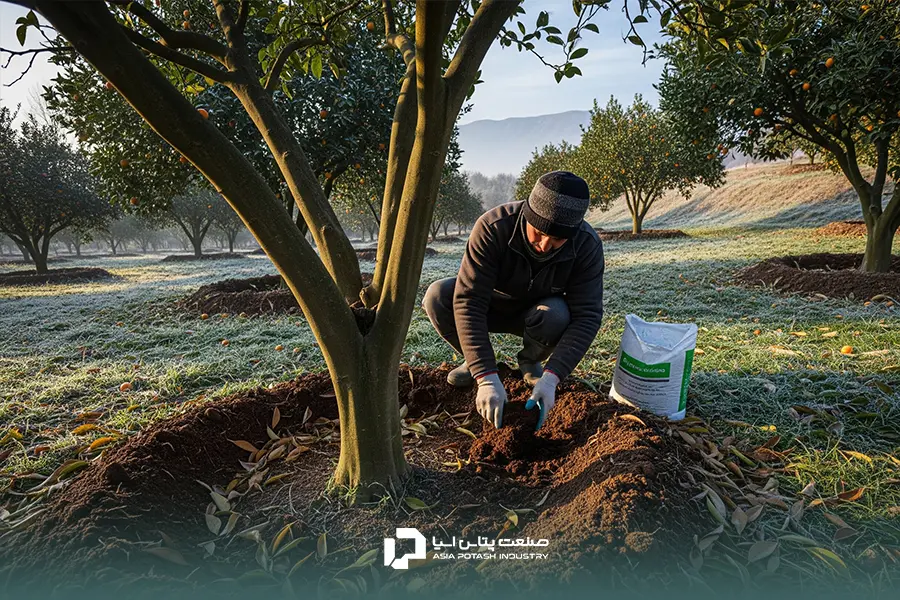
This stage forms the foundation of next season’s growth. The tree restores nutrient reserves consumed in the previous season. The goal is to build a strong nutrient bank in the root zone and improve cold resistance.
Key elements and scientific notes
Focus is on low-mobility elements such as phosphorus (P), potassium (K), sulfur (S), organic matter, and micronutrients. Since P and K move slowly in soil, application via trenching is ideal.
Recommended fertilizers and application (trenching)
- Organic fertilizers: 5–15 kg per bearing tree.
- Phosphate fertilizers: 200–400 g per tree (based on soil test).
- Potassium sulfate: 300–500 g per tree.
- Bentonite sulfur: 500 g to 1 kg per tree for pH adjustment (soil pH adjustment).
- Micronutrients (Fe, Zn, Mn sulfates): 100–150 g per tree each.
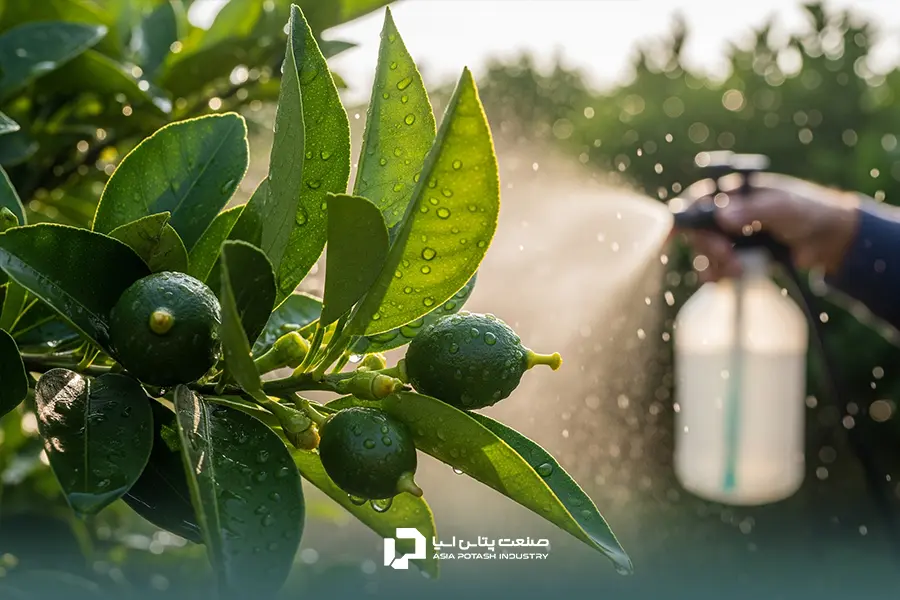
Stage 2: Bud swelling to pre-flowering (late winter)
The tree awakens and prepares for flowering. The goal is uniform bud break and strong flower development.
Key elements and scientific notes
Zinc (Zn) and Boron (B) are critical. Zinc supports auxin production, while boron is essential for pollen germination. Deficiency leads to flower drop and poor fruit set.
Recommended fertilizers
- Zinc chelate or zinc sulfate: foliar spray 2–3 L/kg per 1000 L water.
- Boric acid: 1–1.5 kg per 1000 L water.
- Amino acids: 2 L per 1000 L water to reduce stress and improve resistance.
Stage 3: Full bloom to petal fall
A highly sensitive stage where the tree uses maximum energy for pollination and fertilization.
Key elements and scientific notes
Avoid heavy fertilization. Seaweed extract helps reduce stress and stabilize flowering.
Recommended fertilizers
- Seaweed extract: 1–2 L per 1000 L water.
- Amino acids: 1–2 L per 1000 L water (if stress occurs).
Important note: Avoid mixing pesticides and fertilizers in this stage. See fertilizer compatibility chart.
Stage 4: Fruit set (pea stage)
This stage determines cell division and fruit number. Calcium is critical for cell wall formation.
Key elements and scientific notes
Calcium (Ca) must be available early because later uptake becomes difficult. Boron supports calcium absorption.
Recommended fertilizers
- Calcium nitrate: foliar spray 3–5 kg per 1000 L water (2–3 times every 10 days).
- Calcium-boron fertilizers: specialized formulations.
- Balanced NPK (20-20-20): 10–15 kg/ha via fertigation.
- Iron chelate (EDDHA): 20–50 g per tree if chlorosis appears.

Stage 5: Fruit enlargement (walnut stage to color break)
This is the cell expansion phase where fruits increase in size and weight.
Key elements and scientific notes
Potassium (K) is the dominant element, driving sugar transport and water uptake into fruits.
Recommended fertilizers
- Potassium sulfate (or soluble SOP): 15–20 kg/ha every 15–20 days.
- High-K NPK (12-12-36): 15–25 kg/ha via fertigation.
- Potassium nitrate: early-stage support for K and N.
Stage 6: Ripening and pre-harvest
Focus shifts to improving sugar content, color, and storage life.
Key elements and scientific notes
Potassium and calcium remain essential. Nitrogen should be minimized.
Recommended fertilizers
- Potassium sulfate: final applications (4–5 kg per 1000 L water).
- Calcium nitrate: one spray about a month before harvest.
Note: Avoid mixing calcium and sulfate fertilizers in the same tank.
Citrus fertilization schedule table
This table summarizes the stages for scheduling fertilization:
| Growth Stage | Timing | Main Objective | Key Nutrients | Fertilizer Types | Application Method | Key Notes |
| Post-harvest & dormancy | Late autumn / winter | Rebuild reserves | P, K, Mg, S, micronutrients | Manure, potassium sulfate | Trenching | Avoid nitrogen in fall |
| Bud swelling | Late winter | Stimulate bud break | Zn, B | Zinc, boron fertilizers | Foliar spray | Essential for flowering success |
| Flowering | Spring | Improve pollination | P, B | Seaweed, amino acids | Foliar spray | Avoid heavy fertilization |
| Fruit set | Late spring | Prevent fruit drop | Ca, B | Calcium nitrate, NPK | Foliar + fertigation | Critical calcium window |
| Fruit growth | Summer | Increase size | K, N | High-K fertilizers | Fertigation | Potassium is key |
| Ripening | Late summer / fall | Improve quality | K, Ca | Potassium sulfate | Spray + fertigation | Reduce nitrogen |
How to use Potassium Sulfate for citrus
Annual fertilization program (per hectare)
- Early spring: 100–150 kg/ha to support flowering and early growth.
- Mid-season: 50–100 kg/ha during fruit development.
- Post-harvest: 50–70 kg/ha to restore reserves.
Per tree application
- Young trees (1–3 years): 100–500 g per tree.
- Mature trees: 500–1000 g per tree.
Apply under the canopy and mix with soil or use trenching in winter.
Key notes
- Irrigation is essential: always irrigate after application.
- Compatibility: can be mixed with nitrogen and phosphorus fertilizers after soil testing.
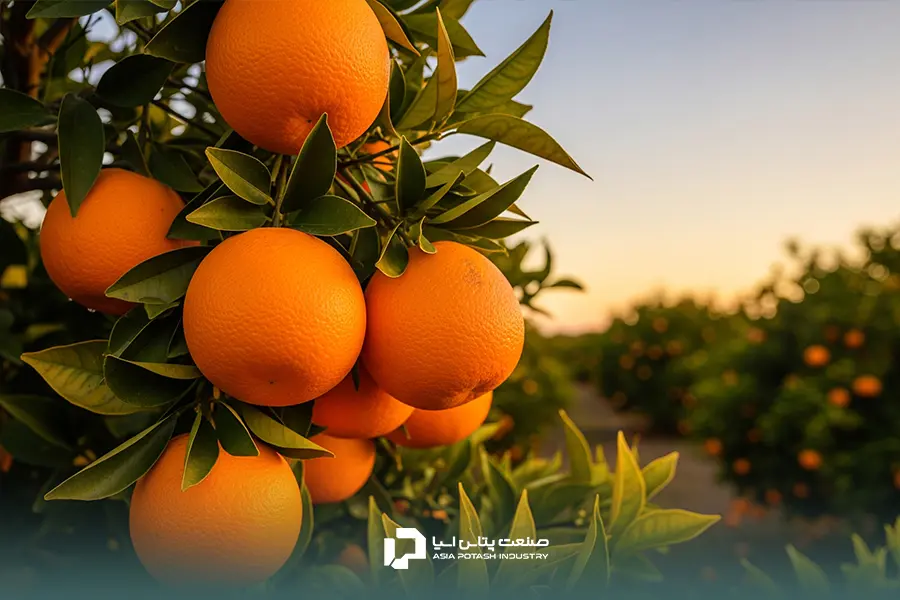
Asia Potash Industry: your partner in achieving high-quality citrus
As mentioned, potassium (K) is the quality element in citrus. It plays a vital role in increasing fruit size, boosting sugar (Brix), improving color, and enhancing stress resistance. Without sufficient potassium, achieving export-quality fruit is nearly impossible.
Asia Potash Industry is proud to supply high-quality agricultural inputs, including Potassium Sulfate with high purity and solubility. Our product offers:
- Rich source of potassium and sulfur
- Low salinity index
- Minimal chloride content
- High solubility for fertigation systems
Using Asia Potash Industry Potassium Sulfate ensures high-quality, large, and flavorful citrus production.
For more information, visit technical datasheet or contact us for distribution opportunities via sales agency page.
Final words
Optimized citrus nutrition is a science, but its implementation is an art of management. This guide provides a complete roadmap. Soil testing, precise timing, and high-quality fertilizers form the three pillars of success. By following a scientific fertilization program, you not only secure this year’s yield but also invest in the long-term health and productivity of your orchard.
Comments (0)
Be the first to comment!