
In recent years, combining fertilization with irrigation has become one of the most effective methods for increasing agricultural productivity. This approach not only saves water and fertilizer consumption but also enables plants to receive nutrients at the right time and in precise amounts. Understanding fertilization methods in different irrigation systems helps farmers choose the most suitable approach based on soil type, crop, and available resources.
In this article from Asia Potash Industry Agricultural Magazine, we provide a complete review of irrigation systems and fertilization methods in each one—from traditional flood irrigation to advanced subsurface and drip systems—making it easier to select the most suitable system for each farm.
Fertilization in surface (flood or furrow) irrigation
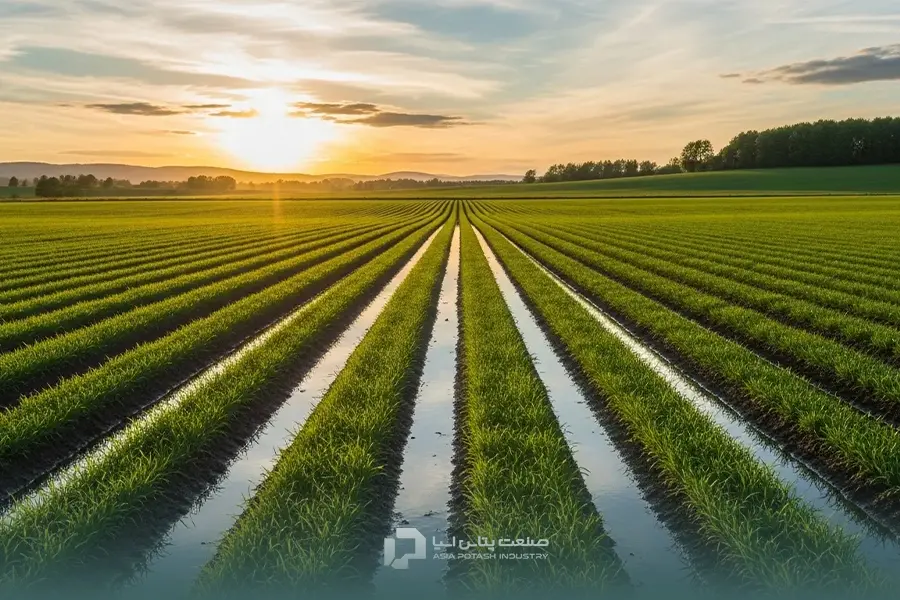
In many regions, surface irrigation is still one of the most common methods for watering fields. In this system, water is distributed through furrows or basins to reach plant roots. When combined properly with fertilization, this system can significantly increase productivity.
How fertilization is performed in surface irrigation
In flood or furrow irrigation systems, fertilizer is usually injected in dissolved form into the water and moves along the soil surface with the water flow. Nutrient-rich water enters from the top of the field or head of the furrow and distributes nutrients across the farm during movement. The more optimal the infiltration rate, the more effective nutrient uptake in the root zone will be.
To achieve the best results, farmers typically dissolve soluble fertilizers such as ammonium nitrate or urea in a tank or barrel before irrigation and inject it into the water flow. In some cases, fertilizer is directly added into the irrigation channel so it disperses with the water across the field.
Best timing for fertilization in surface irrigation
Timing of fertilizer injection is critical. If applied too early, part of the fertilizer is lost before reaching the end of the field. If applied too late, insufficient absorption occurs.
The best time for injection is usually when the water has traveled about halfway through the field. At this stage, nutrient distribution becomes more uniform and the risk of leaching into deeper soil layers is reduced.
Advantages of fertilization in surface irrigation
- Simple implementation: Requires no special equipment or complex injection systems.
- Low initial cost: The most economical option for small and traditional farms.
- Use of local experience: Farmers can adjust timing and dosage based on field knowledge.
- High efficiency in heavy soils: Clay soils allow longer nutrient contact time with roots.
- Compatibility with traditional irrigation systems: Fertilization can be added without major system changes.
Limitations and challenges
- Uneven nutrient distribution: Head-end areas receive more fertilizer than tail-end zones.
- Nutrient loss: Especially in light soils or hot conditions, leaching and evaporation occur.
- High dependency on water management: Poor flow control reduces efficiency.
- Uneven crop growth: Nutrient variation leads to inconsistent plant development.
- Limited precision in fertilizer formulation: Nutrient ratios are harder to control.
Despite these limitations, with proper control of timing, water flow, and fertilizer type, surface irrigation can still achieve acceptable efficiency.
Best fertilizers for surface irrigation
Fertilizers used in this system must be highly water-soluble and quickly available to plant roots. Urea, ammonium nitrate, potassium nitrate, and ammonium phosphate are commonly used options.
Liquid fertilizers have also become increasingly popular due to better solubility and more uniform distribution in water flow.
For vegetative growth, nitrogen fertilizers such as urea are suitable. For flowering and fruit quality improvement, phosphorus and potassium fertilizers are recommended. Overall, fertilizer selection should be based on crop growth stage and soil status.
Fertilization in drip irrigation
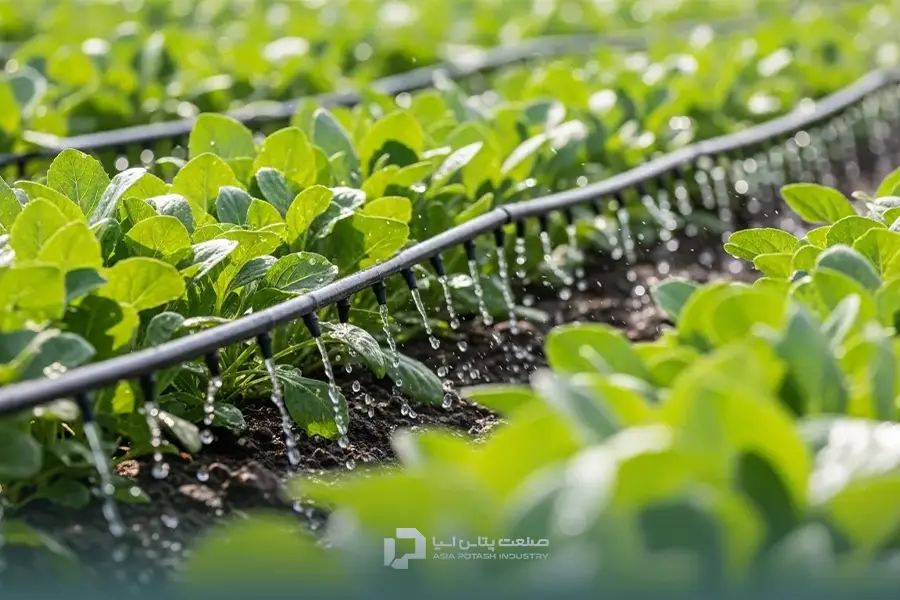
Drip irrigation is one of the most precise and efficient irrigation methods in modern agriculture. In this system, water and fertilizers are delivered directly and drop by drop to the root zone.
This ensures each plant receives exactly what it needs, minimizing water and nutrient losses. Fertilization in drip irrigation, also known as fertigation, is one of the most efficient nutrient management methods in arid and semi-arid regions.
Injection and management of fertilizers in drip systems
In drip systems, fertilizer is added to the irrigation line through a tank connected to the main pipeline. A dosing pump or Venturi system injects the fertilizer solution under controlled pressure.
Proper dissolution is essential to prevent clogging of emitters. In greenhouses and orchards, fertilization programs are usually staged—for example, nitrogen during vegetative growth and potassium during flowering.
pH and EC control of irrigation water is critical. High alkalinity or salinity reduces fertilizer solubility and system efficiency.
Regular filtration, pipe flushing, and water quality monitoring are essential requirements.
Advantages of fertilization in drip irrigation
- Higher fertilizer efficiency: Nutrients are delivered directly to active root zones.
- Water savings: Localized irrigation minimizes evaporation and runoff.
- Uniform feeding: All plants receive balanced nutrition.
- Precise nutrient control: Fertilizer type and dose can be adjusted per growth stage.
- Reduced fungal diseases: Dry foliage reduces pathogen development.
- Suitable for sloped or uneven land: Controlled pressure ensures uniform distribution.
Key considerations for fertilizer selection in drip systems
Not all fertilizers are suitable for drip irrigation. Fertilizers must be fully soluble, free of suspended particles, and chemically compatible with irrigation water.
Key rules for drip fertigation
- Use fully soluble fertilizers such as ammonium nitrate, potassium nitrate, ammonium phosphate, or magnesium sulfate.
- Do not inject phosphorus and calcium fertilizers simultaneously due to precipitation risk.
- Maintain irrigation water pH between 5.5 and 6.5 for optimal absorption.
- Filter solutions through 100-micron filters before injection.
- Design fertilization programs based on soil testing and crop growth stage.
Fertilization in sprinkler irrigation
Sprinkler irrigation is widely used in large farms and commercial orchards. Water is sprayed over the field in fine droplets through nozzles. When combined with fertilization, nutrients are distributed across soil and foliage and reach the root zone.
Methods of fertilization in sprinkler systems
- Direct injection: Fertilizer is injected into the main pipeline and distributed through sprinklers.
- Localized fertilization: Specific nozzles target defined zones for more precise application.

Best timing for fertilizer injection in sprinkler systems
The optimal time is mid-irrigation, when soil is moist but not saturated. This ensures better nutrient infiltration and reduces leaching.
Best fertilizers for sprinkler irrigation
- High solubility in water to prevent nozzle clogging.
- pH compatibility with irrigation water to avoid precipitation.
- Thermal stability in hot climates.
- Non-corrosive properties to protect equipment.
Nitrogen fertilizers such as ammonium nitrate and potassium nitrate are typically the best choices.
Advantages of sprinkler fertigation
- Uniform distribution of water and nutrients.
- Adjustable fertilizer concentration.
- Possibility of foliar nutrient application.
- Reduced soil erosion.
- Suitable for light soils and mild slopes.
Limitations of sprinkler fertigation
- Weather dependency (wind and heat reduce efficiency).
- Nozzle clogging risk.
- Reduced efficiency during rainfall or high humidity.
- Maintenance costs.
- Risk of leaf burn under improper concentration.
Fertilization in subsurface irrigation
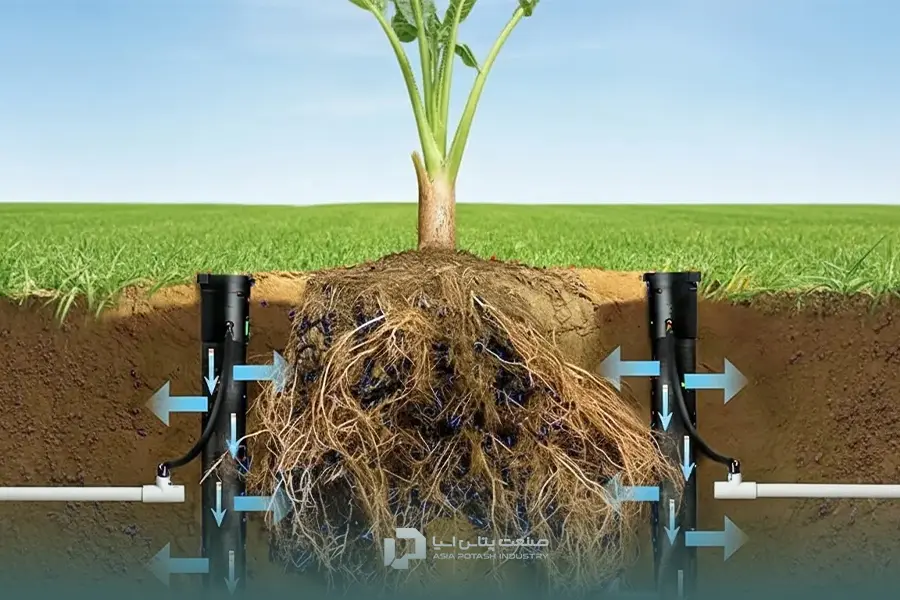
Subsurface irrigation is one of the most advanced and efficient irrigation methods. Water and nutrients are delivered directly to the root zone through buried pipes.
This system minimizes evaporation and improves fertilizer efficiency, especially in dry regions.
System operation and fertilizer injection
Pipes are installed 20–40 cm below the soil surface and deliver water and nutrients directly to roots.
- Fertilizer solution must be free of particles.
- Pressure must be uniform across the system.
- System should be flushed after each injection.
Advantages of subsurface fertigation
- High water and fertilizer efficiency.
- Reduced surface salinity.
- Weed suppression due to dry soil surface.
- Improved crop quality and uniform growth.
- Precise nutrient control.
- Long-term soil stability.
Challenges
- High installation cost.
- Need for advanced filtration.
- Difficult troubleshooting.
- Limitations in heavy soils.
- Requires technical expertise.
Fertilization in center pivot irrigation
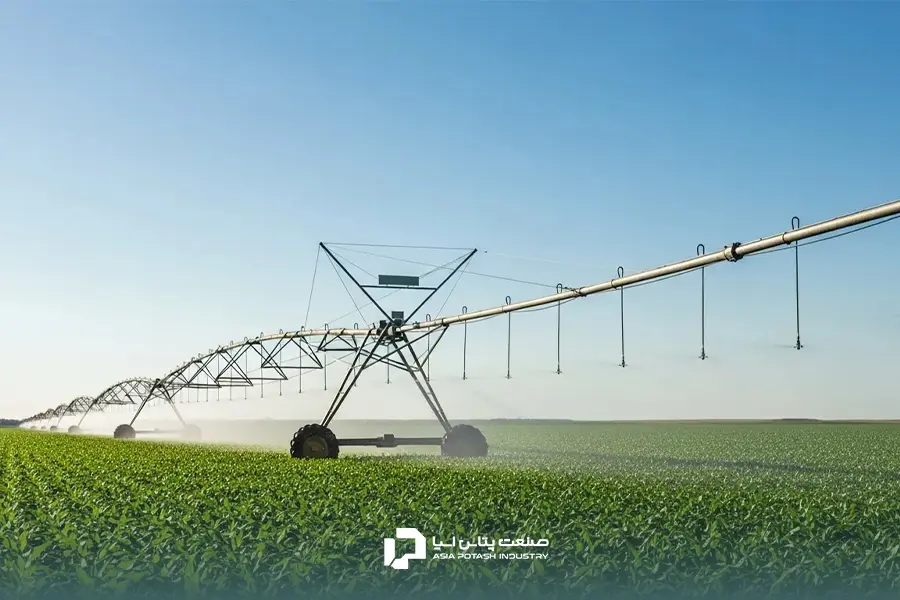
Center pivot irrigation is a mechanized system used in large-scale farming. Water is distributed through rotating sprinkler arms. Fertilization requires precise planning and equipment.
Fertilizer injection method
- Proper concentration based on water volume and system speed.
- Injection usually occurs mid-rotation for uniform distribution.
- Filtration is essential to prevent clogging.
Only fully soluble fertilizers such as nitrates, sulfates, and phosphates are suitable.
Advantages of center pivot fertigation
- Uniform coverage of large fields.
- Reduced labor requirements.
- Precise control of fertilizer dose.
- Reduced soil erosion and nutrient runoff.
- Combined application of fertilizers and pesticides.
Limitations
- High installation and maintenance costs.
- Dependence on electricity.
- Need for regular servicing.
- Sensitivity to water quality.
- Limited use in uneven terrain.
Key points and common mistakes in fertigation systems
Proper fertigation requires technical precision and management. Soil testing is essential before application. Measuring soil pH and adjusting it when necessary can significantly improve efficiency.
A common mistake is mixing incompatible fertilizers, which can cause precipitation and clog irrigation systems.
Hard or contaminated water reduces solubility and system performance.
Incorrect pressure settings can lead to uneven distribution or equipment damage.
Timing must align with crop growth stages—for example, phosphorus supports root development and flowering initiation, while potassium improves fruit development and quality.
Proper management increases yield while reducing waste and environmental impact.
Professional fertigation solutions with Asia Potash Industry
If you want to implement professional and optimized fertigation systems, using specialized products and services makes a significant difference. Asia Potash Industry provides high-quality Potassium Sulfate and technical support to help farmers improve fertilizer efficiency and crop yield.
By consulting with their experts, you can design a customized fertilization program for your farm.
Conclusion
Fertigation across different irrigation systems—surface, drip, subsurface, and sprinkler—plays a critical role in improving crop performance. Each system has its own advantages and limitations, and success depends on proper fertilizer selection, timing, and management.
Combining technical knowledge, experience, and high-quality inputs leads to better yields, resource efficiency, and improved crop quality. Precision is the key to modern fertigation success.
Comments (0)
Be the first to comment!