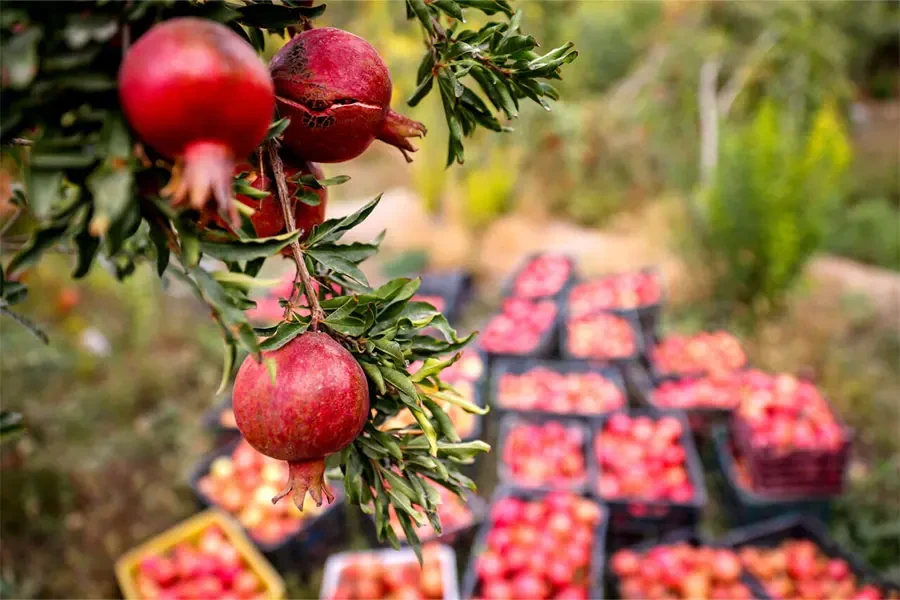
Execution of a proper nutritional program for the pomegranate tree can significantly improve fruit sugar content, skin thickness, and resistance to cracking. Many farmers, despite years of experience, are unable to reach maximum productivity and fruit quality due to not following the correct principles of pomegranate fertilization.
In this article from Asia Potash Industry Agriculture Magazine, you will become familiar with the best fertilizer for pomegranate trees, proper timing, and a complete program for tree nutrition so that at the end of the season you can harvest a high-quality, high-yield, and marketable product.
Why is the pomegranate fertilization program important?
Pomegranate trees require a wide range of nutrients to produce large, sweet fruits with firm skin. An incorrect fertilization program not only reduces yield quantity but also leads to reduced fruit shelf life, fruit cracking, and increased susceptibility to pests and diseases.
The pomegranate fertilization program pursues four main objectives:
1.Increasing flower number and fruit set
2.Improving fruit quality (sweetness, color, and size)
3.Strengthening the tree’s resilience against environmental stresses
4.Storing nutrients for next year’s production
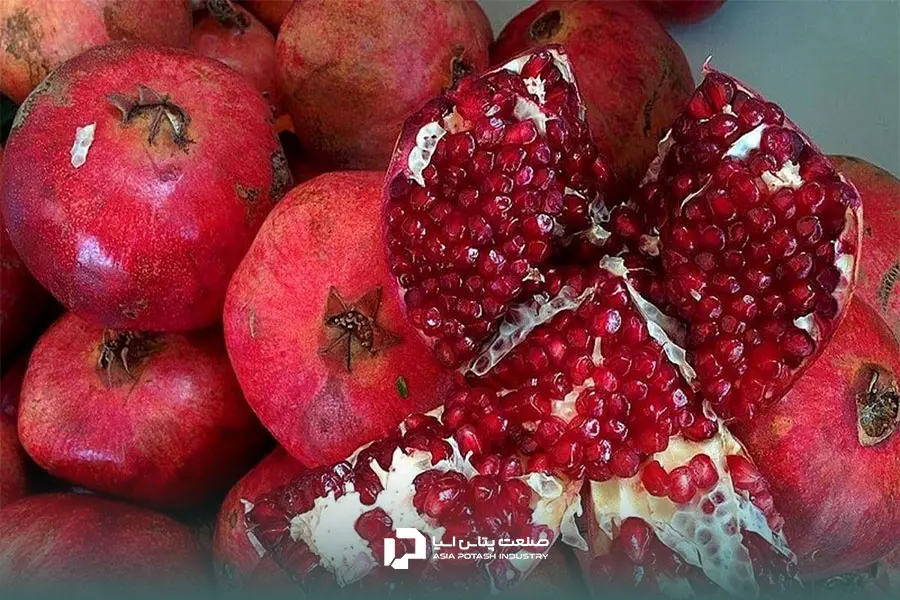
Understanding the nutritional needs of pomegranate trees: from macro to micronutrients
Selecting the best fertilizer for pomegranate requires a precise understanding of the role of each element in the growth cycle of the tree. Pomegranate trees need a complete set of nutrients for high-quality and productive yields, each of which plays a specific role.
The important point is that the deficiency of even one element can affect the entire growth cycle of the tree. Below, we examine the most important nutrients and their roles in the health and productivity of pomegranate trees.
Main elements (macronutrients)
- Potassium (K): This element is the most important factor in determining pomegranate quality. The role of potassium in plant growth and development, especially in sugar transport to fruits, increasing fruit size, improving taste and sweetness, reducing cracking, and improving shelf life, is undeniable.
- Phosphorus (P): Essential for strong root development, flowering, and successful fruit formation.
- Nitrogen (N): Necessary for vegetative growth and greenness; however, excessive use leads to excessive leaf and shoot growth, reduced fruiting, and weakened resistance to pests.
Essential micronutrients
- Calcium (Ca): Increases fruit cell wall strength and prevents cracking and blossom-end rot.
- Boron (B): Essential for pollination, fruit formation, and sugar transport. Boron deficiency is one of the main causes of flower drop and malformed fruits.
- Zinc (Zn): Plays a key role in auxin hormone production and formation of next year’s flower buds.
Best fertilizer for pomegranate trees: from basic to specialized
Choosing the best fertilizer for pomegranate trees is one of the most important decisions a grower must make to achieve maximum yield and highest fruit quality. This choice depends on several factors, and a fixed formula cannot be recommended for all orchards.
Factors such as tree age, soil type, and climate conditions all play a role in determining the best nutritional program. A young tree that has not yet reached full production has completely different needs compared to a mature, high-yielding tree.
Below, we examine two main categories of fertilizers used in pomegranate orchards. This classification helps you choose the best combination based on your orchard conditions.
Organic fertilizers
Organic fertilizers used in pomegranate orchards generally include the following three types:
- Fully decomposed animal manure: Using fully decomposed manure in the most important fertilization season, autumn, improves soil structure, increases beneficial microbial activity, and provides gradual nutrient supply.
- Compost: An excellent source for improving soil texture and increasing water retention capacity.
- Vermicompost: Due to its natural growth hormones, it is very effective for root development and increasing tree resistance.
Chemical fertilizers
For chemical fertilizers for pomegranate trees, you can use the following:
- Potassium Sulfate: This fertilizer is the best source of potassium for pomegranate trees. Its high potassium content and very low chlorine make it ideal for improving fruit sweetness and quality.
- Simple superphosphate: A concentrated and effective source of phosphorus for root development. It should be noted that triple superphosphate may pose food safety concerns, so simple phosphate fertilizers are preferred.
- Urea: A nitrogen source for vegetative growth, which must be used carefully and at the proper time.

Methods of pomegranate fertilization: from traditional to modern
Choosing the correct fertilization method is as important as selecting the fertilizer itself. A suitable method ensures that nutrients reach the root zone efficiently and reduces waste. Understanding different fertilization methods allows you to choose the best approach based on tree age, fertilizer type, soil texture, and irrigation system.
1. Pit application (deep placement)
This is one of the most efficient methods for mature fruit trees, including pomegranate. In this method, pits are dug around the canopy projection and fertilizers are placed inside them. This ensures nutrients are placed directly in the root zone and reduces losses, especially for immobile nutrients like phosphorus.
2. Fertigation
In this method, water-soluble fertilizers are applied through irrigation systems (drip or sprinkler). This approach is ideal for orchards equipped with pressurized irrigation systems.
It significantly reduces water and fertilizer consumption, allows rapid and uniform nutrient uptake, and enables precise fertilization at different growth stages.
3. Surface broadcasting
In this method, fertilizer is evenly spread on the soil surface and then mixed with soil through irrigation or light tillage. It is suitable for fast-absorbing nitrogen fertilizers such as urea.
Its advantages include speed, low labor requirement, and suitability for different growth stages. However, it may cause nutrient loss through volatilization or leaching and promote weed growth.
4. Foliar spraying
In this method, liquid fertilizers are sprayed directly onto leaves. It is highly effective for supplying micronutrients quickly and correcting nutrient deficiencies during critical growth stages.
It allows rapid absorption and serves as an immediate solution for nutrient deficiencies.
Which fertilization method is best for your orchard?
For pomegranate orchards, the best results usually come from a smart combination of different methods throughout the year. In summary:
- Young trees: pit application or fertigation
- Mature trees: combination of pit application (base fertilization) and fertigation (stage-based feeding)
- For quick deficiency correction: foliar spraying
- Light soils: frequent fertigation with lower doses
- Heavy soils: pit application or surface broadcasting

Timing of pomegranate fertilization: a step-by-step roadmap
Determining the correct timing of fertilization is the art of matching the tree’s nutritional needs with its natural growth cycle. Many farmers fail to achieve optimal results despite using high-quality fertilizers because of incorrect timing.
Pomegranate trees go through different growth stages throughout the year, each with specific nutritional requirements. Incorrect fertilization timing not only wastes financial resources but may also harm tree health.
The fertilization program is structured across four main seasons. Below we examine each stage in detail.
Stage 1: Autumn (after harvest)
This is the most important fertilization season for restoring tree vigor and storing energy for the next year. After harvest, the tree is weakened and needs full nutrition.
Stage 2: Late winter (before bud swelling)
This stage is crucial for strengthening flower buds and preparing the tree for spring growth.
Stage 3: Spring (after initial fruit set)
At this stage, the tree focuses on early fruit development and requires balanced nutrition to prevent fruit drop and support growth.
Stage 4: Summer (fruit enlargement and sweetness stage)
This stage determines final fruit quality, including size, taste, color, and firmness.
Pomegranate fertilization table: a complete operational plan
This table is a practical guide for farmers. The values are for mature, productive trees and should ideally be adjusted after soil and leaf analysis.
| Season | Growth stage | Best fertilizer | Dosage (per mature tree) | Application method | Main goal |
| Autumn | After harvest | Fully decomposed manure | 20–30 kg | Pit application | Soil improvement and energy storage |
| Autumn | After harvest | Potassium Sulfate | 400–600 g | Pit application | Strengthening tree vigor and next year buds |
| Autumn | After harvest | Simple superphosphate | 200–300 g | Pit application | Root development |
| Winter | Before bud swelling | Potassium Sulfate | 300–500 g | Pit application | Strengthening flower buds |
| Winter | Before bud swelling | Simple superphosphate | 150–250 g | Pit application | Improving flower formation |
| Spring | After fruit set | NPK fertilizer | 200–400 g | Fertigation | Supporting fruit growth |
| Spring | After fruit set | Zinc sulfate + boric acid | 2–3 g/L | Foliar spray | Improving fruit set and retention |
| Summer | Fruit enlargement | Potassium Sulfate | 300–500 g | Fertigation | Increasing sweetness and size |
| Summer | Fruit enlargement | Calcium nitrate | 5–10 g/L | Foliar spray | Reducing cracking and improving firmness |
Common mistakes in pomegranate fertilization
Here we discuss common mistakes in pomegranate fertilization that reduce yield and quality:
- Excess nitrogen in spring and summer: reduces fruit size and quality.
- Ignoring potassium fertilization: leads to small, less sweet fruits and increased cracking.
- Surface fertilization without soil incorporation: causes nutrient loss.
- Using fresh manure: causes root damage and weed growth.
- Ignoring soil and leaf analysis: leads to imbalanced fertilization and waste.
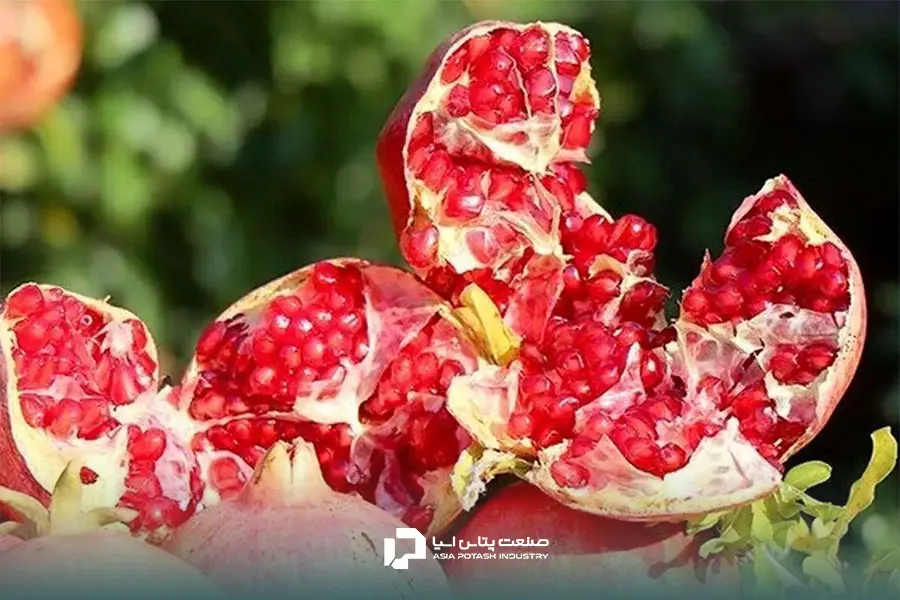
Asia Potash Industry: supporting high-quality pomegranate production
The quality and sweetness of pomegranate fruit are directly related to the purity and quality of potassium fertilizers used. Low-purity potassium fertilizers with high chlorine content can reduce fruit quality and increase cracking.
Potassium Sulfate Asia Potash Industry, with high potassium content (K₂O) and very low chlorine content (less than 1.5%), is an ideal and safe choice for pomegranate orchards.
Conclusion
Pomegranate fertilization is a smart investment for achieving high-quality, marketable, and productive yields. By following a proper fertilization program and using high-quality inputs such as Potassium Sulfate, you can significantly increase orchard profitability.
Proper nutrition is the difference between an ordinary orchard and a highly productive one.
Comments (0)
Be the first to comment!