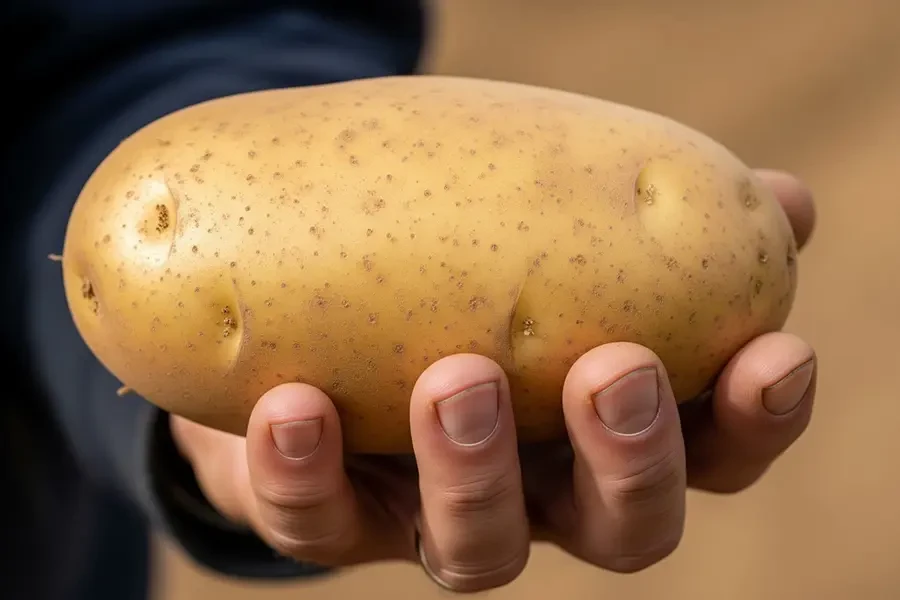
Achieving high potato yield is more of a well-planned strategy than a coincidence. This article is your comprehensive guide and roadmap to increasing potato yield; a practical instruction that shows you how, using scientific methods and proper nutrition, you can achieve higher potato production in your field and gain maximum profit from potato cultivation.
Why is increasing potato yield important?
In modern agriculture, increasing potato yield means higher profitability and better efficiency in the use of resources such as water, soil, and inputs. A strong, high-performing potato plant can return your investment in the best possible way and pave the path toward sustainable agriculture. Any country that aims to rely on agriculture as a major source of income and gain global recognition must move toward higher production; otherwise, it is wasting its resources.
Comprehensive roadmap for increasing potato yield
To achieve maximum potato yield, a multi-stage process must be followed. Following this roadmap is the most reliable method for increasing potato production.
Essential pre-planting actions
Increasing potato yield starts with the actions you take before planting. These include soil engineering, selecting the right variety, and ensuring soil health:
Soil engineering
Increasing potato yield depends heavily on your soil. To better understand your field, you should conduct a soil test. This is the beginning of scientific agriculture and helps you make decisions based on data rather than guesswork.
Soil testing tells you what deficiencies your soil has, what its acidity status or pH is, and how much nutrients it contains.
One of the most important results of this test is soil pH. Potatoes perform best in soil with a pH between 5.5 and 7.5. If the soil is too alkaline, not only is nutrient absorption disrupted, but it also creates conditions for destructive diseases such as common scab, which significantly reduces product quality.
Read More: How to adjust soil pH?
After understanding the soil, you need to optimize its structure. Potatoes require loose and well-aerated soil for proper tuber expansion. If your soil is heavy and clayey, adding fully decomposed organic matter (compost) will soften it, improve aeration, and support healthy tuber development.
Choosing the right variety
Now that the soil is prepared, it is time to choose the seed. The genetic potential of the variety determines your maximum yield. You cannot expect exceptional production from a seed with only average potential. Variety selection must be strategic. For example, if your soil is prone to scab disease, choosing a resistant variety is a strategic decision that saves you future problems.
The table below presents the best potato seed varieties in Iran, allowing you to choose the best option based on your goals and conditions to increase yield.
|
Variety Name |
Growth Period |
Tuber Shape & Color |
Main Uses |
Key Resistances |
Yield Potential |
|
Agria |
Medium-late |
Elongated oval, cream skin, yellow flesh |
Processing (fries), fresh consumption |
Virus resistant, sensitive to blackleg |
Very high |
|
Marfona |
Medium-early |
Round to oval, light yellow skin and flesh |
Fresh consumption |
– |
High |
|
Jelly |
Medium-late |
Oval, yellow skin and flesh |
Fresh consumption, chips |
Resistant to blackleg, blight, scab |
Very high |
|
Savalan |
Late |
Round, yellow skin with red eye spots |
Fresh consumption, processing |
– |
High |
|
Fontane |
Medium-early |
Large oval, yellow skin, light yellow flesh |
Chips, fries |
– |
High |
|
Arinda |
– |
Yellow skin, light yellow flesh |
– |
– |
Very high |
|
Pashandi |
Late |
Thick scaly skin, white to cream flesh |
Fresh consumption, storage |
Good storage ability |
– |
Ensuring seed tuber health
Finally, the most important input is the seed tuber itself. Using certified and healthy seed is the best way to prevent destructive diseases from entering the field. Another effective technique is pre-sprouting (chitting).
For this, tubers are exposed to light and mild temperatures before planting so that strong sprouts develop. This ensures faster and more uniform emergence, giving you an early advantage from the start.
Fertilization and nutrition during the growing season
Once the plant grows, nutrient management becomes like managing a football team; each element must enter at the right time. A single fertilizer program for all stages is inefficient and incorrect.
In early growth stages, the plant is building foliage, so it needs nitrogen (N) and phosphorus (P) for strong leaves and roots. However, excessive nitrogen can delay tuber formation.
When the plant enters tuber formation, the strategy changes. Phosphorus demand remains high for more tuber initiation, while nitrogen should gradually decrease.
The most important stage for yield increase is tuber bulking. At this stage, potassium (K) is the key nutrient. Potassium is responsible for transferring sugars and energy from leaves to tubers and storing them as starch.
Excess nitrogen at this stage is a serious mistake. It causes excessive vegetative growth instead of tuber enlargement, leading to wasted energy and reduced yield. For proper guidance, you can refer to our detailed article on fertilizing potatoes.
Efficient and precise irrigation
Water and nutrients are closely connected. Potato sensitivity to water varies across stages. The most critical stage is the onset of tuber formation.
Any water stress during this period reduces the number of tubers, causing irreversible yield loss.
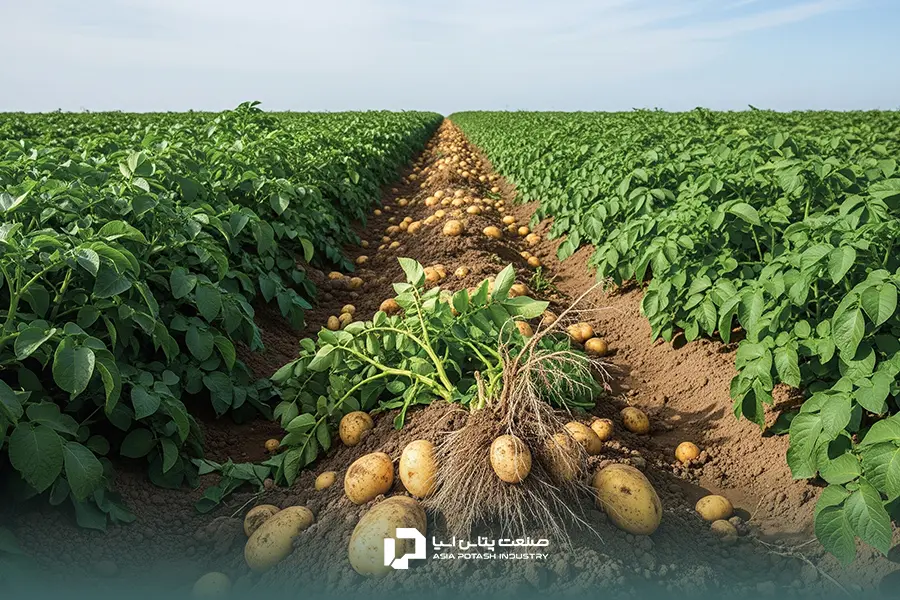
Over-irrigation is also harmful, leading to root suffocation and disease spread. Drip irrigation is the most efficient method, saving water and enabling fertigation—delivering nutrients directly to the roots at the right time. This synergy significantly increases productivity compared to traditional methods.
Disease and pest management
Now that you have created high yield potential, you must protect it from pests and diseases. The best defense is prevention: healthy seeds, resistant varieties, and crop rotation (avoiding planting potatoes in the same field for several years).
One of the most important field practices is hilling (earthing up), which:
- Protects tubers from sunlight exposure and greening
- Creates a suitable environment for tuber expansion
- Controls weeds
- Acts as a physical barrier against pests like potato tuber moth and late blight
Types of fertilizers for increasing potato yield
Base fertilizers (pre-planting)
Base fertilizers include triple superphosphate (phosphorus supply), Potassium Sulfate (potassium supply), and fully decomposed organic matter (compost). Compost improves soil structure for better tuber growth.
Read More: What is Potassium Sulfate?
Vegetative growth fertilizers
During early growth, when the plant develops leaves and roots, it requires high nitrogen (N) and phosphorus (P).
Fertilizers like urea and ammonium sulfate provide nitrogen for greening.
Starter fertilizers with high phosphorus such as 10-52-10 support strong root development.
Tuber formation and bulking fertilizers
- High-potassium fertilizers: Potassium (K) is the most important element for increasing tuber size and weight. The best potassium fertilizer at this stage is Potassium Sulfate and balanced high-potassium formulas such as 36-12-12.
- Liquid high-potassium fertilizers: In final bulking stages, highly concentrated potassium solutions such as K60 or K80 applied via drip irrigation greatly increase final tuber weight.
Read More: What is high-potash fertilizer?
Micronutrient fertilizers
Final yield can be limited by deficiency of a single micronutrient. Therefore, complete micronutrient fertilizers containing calcium (Ca), magnesium (Mg), zinc (Zn), and boron (B) are essential for maximum yield. 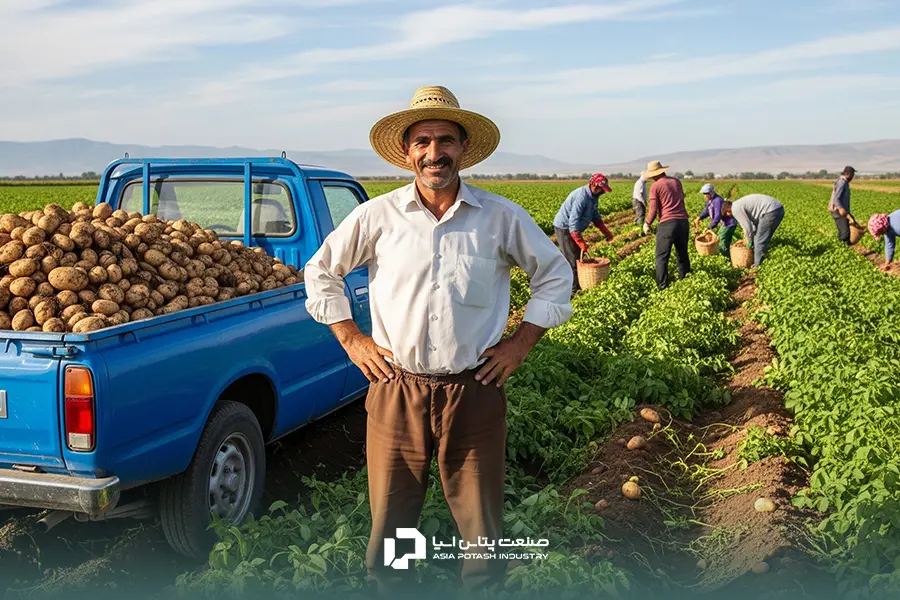
What is the best fertilizer for increasing potato yield?
If we want to identify a single most effective fertilizer for increasing potato yield, it is potassium (K).
Potassium is responsible for transferring sugars and energy from leaves to potato tubers. The better this process occurs, the larger and heavier the tubers become, resulting in higher yield.
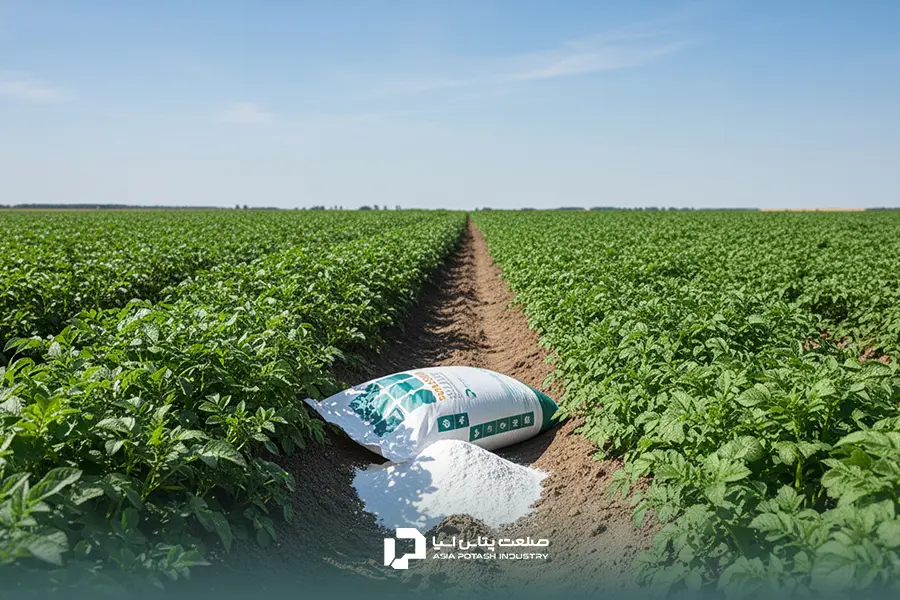
The most effective form of potassium fertilizer is Potassium Sulfate. Due to its high potassium content and low chloride level, it significantly increases tuber weight and yield. It is also 100% water-soluble and suitable for fertigation.
Purchasing Potassium Sulfate for increasing potato yield
At Asia Potash Industry, we focus on your success. With modern knowledge, we produce products specifically formulated to increase potato yield and other strategic crops.
Our Potassium Sulfate fertilizer is a powerful tool for achieving new yield records. To view specifications of our Potassium Sulfate fertilizer, visit the product page, and for sales agents, contact us.
Final words
Increasing potato yield is a multi-dimensional process where every stage matters. By following a precise roadmap and using high-quality inputs such as the best fertilizers for yield increase, you can successfully complete this process and achieve your goals. You can always rely on our experts for support.
If you found this article useful, share it with your colleagues. We would also be happy to hear your feedback or experiences regarding increasing potato yield; feel free to leave a comment below.
Comments (0)
Be the first to comment!