
Sesame, this valuable oilseed and nutrient-rich crop, has high profitability potential for farmers. However, achieving maximum yield and the highest oil content depends primarily on the scientific fertilization program of this plant. A sesame fertilization program that is implemented scientifically and step by step can make the difference between an average harvest and an exceptional one.
In this comprehensive article from the Asia Potash Industry Agricultural Magazine, we aim to fully address the subject of sesame fertilization and provide you with nutritional requirements, types of fertilizers for sesame, fertilization programs, and a precise fertilization timetable so you can maximize your yield.
Why is scientific sesame fertilization so important?
It may seem that sesame is a resilient crop and does not require complex nutritional management; however, this assumption can lead to a severe reduction in yield. Strategic fertilization of sesame is essential for the following reasons:
- Increasing number of pods: Proper nutrition in early stages strengthens the plant and increases its capacity to produce more flowers and pods.
- Increasing thousand-seed weight: Key elements such as potassium directly contribute to seed filling and final yield weight.
- Increasing oil percentage: The economic value of sesame depends on its oil content. Elements such as sulfur and potassium increase seed oil percentage.
- Increasing stress resistance: A well-nourished plant shows higher resistance to environmental stress, pests, and diseases.
Neglecting the sesame fertilization program can easily waste all your effort and investment. Therefore, any farmer who values their work should take this seriously and implement a scientific program in consultation with agricultural experts.
🌱 Read More: What are the symptoms of sulfur deficiency in plants?
Nutrient requirements of sesame
Successful sesame fertilization begins with understanding the nutritional needs of the plant. These needs are divided into two main categories: macronutrients and micronutrients.
1. Macronutrients
- Nitrogen (N): The engine of vegetative growth. However, its management is very sensitive; excessive use leads to weed growth and reduced seed formation.
- Phosphorus (P): Essential for root development, flowering, and ATP energy production. Without sufficient phosphorus, nitrogen efficiency also decreases.
- Potassium (K): Known as the “quality element,” it plays a vital role in nutrient transport, seed filling, oil synthesis, and plant resistance.
- Sulfur (S): A key component in amino acid formation and oil synthesis in sesame.
- Calcium (Ca) and Magnesium (Mg): Essential for cell wall strength and photosynthesis, respectively.
2. Micronutrients
These elements are required in small amounts, but deficiency in any of them can cause crop failure.
- Zinc (Zn): Directly involved in pollination and seed formation.
- Boron (B): Essential for successful fertilization and capsule formation. Without sufficient boron, normal seed formation will not occur despite flowering.
- Iron (Fe) and Manganese (Mn): Involved in chlorophyll formation; deficiencies are common in alkaline soils.
🌱 Read More: What is the role of potassium in plants?
Table of nutrients and deficiency symptoms in sesame
|
Nutrient |
Key role |
Deficiency symptoms |
|
Nitrogen (N) |
Vegetative growth, chlorophyll production |
Uniform yellowing in older leaves |
|
Phosphorus (P) |
Root development, energy transfer, flowering |
Stunted growth, dark green or purplish leaves |
|
Potassium (K) |
Quality, seed filling, oil synthesis, stress resistance |
Yellowing and burning at leaf edges |
|
Sulfur (S) |
Amino acid and oil synthesis |
Yellowing of young leaves |
|
Zinc (Zn) |
Pollination, seed formation, growth hormones |
Short internodes, small and deformed leaves |
|
Boron (B) |
Fertilization, capsule formation |
Death of apical buds, weak flowering, no capsule formation |
Types of fertilizers for sesame
A successful sesame fertilization program uses a smart combination of different fertilizers. Using only one type is not sufficient.
Organic and bio fertilizers for sesame
- Animal manure (cow and poultry): Best option for improving soil structure and providing gradual nutrients before planting. Must be fully decomposed.
- Vermicompost: In addition to nutrition, it contains growth hormones that significantly improve yield and oil content.
- Humic acid: A powerful soil conditioner that greatly enhances the absorption of other fertilizers.
- Biofertilizers: Such as nitrogen-fixing bacteria (Nitroxin) and phosphate-solubilizing bacteria (Bio-phosphate), which make locked nutrients available to the plant.
Chemical fertilizers for sesame
- Nitrogen sources: Urea, ammonium sulfate (a smart choice due to sulfur content).
- Phosphorus sources: Triple superphosphate, diammonium phosphate.
- Potassium sources: Potassium Sulfate is the best option for sesame because it provides high-quality potassium along with sulfur and contains no harmful chloride. If you don’t know what Potassium Sulfate fertilizer is, read our article about it.
- Complete fertilizers (NPK): such as 20-20-20 or high-potash fertilizer for late growth stages.
- Micronutrient fertilizers: in sulfate or chelated forms for better absorption in Iranian soils.
📌 More information:
Many farmers tend to mix different fertilizers together to save time and cost. While this can be efficient, it may also cause serious issues without proper knowledge.
Some fertilizer combinations lead to unwanted chemical reactions, precipitation of nutrients, and reduced plant availability.
This problem is especially important in fertigation systems and may cause clogging of pipes and drippers. To avoid these issues, it is recommended to review our article on fertilizer compatibility table before mixing any products.
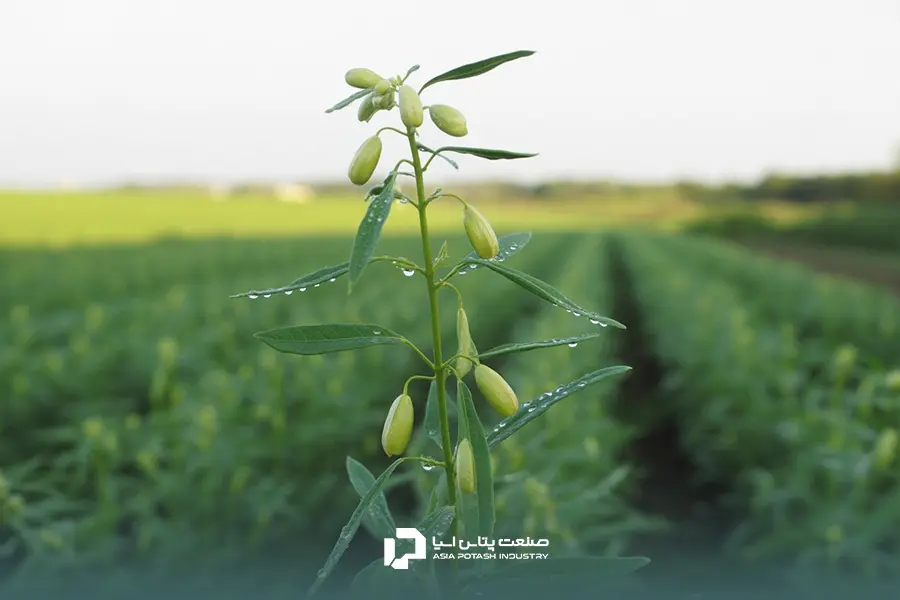
Step-by-step sesame fertilization program
A successful fertilization program considers the nutritional needs of sesame at each growth stage. Using a single fertilizer throughout the season will result in nutrient imbalance, reduced yield, and lower oil content.
Below is a detailed sesame nutrition program by key growth stages.
Stage 1: Land preparation before planting
This is the foundation of the entire crop cycle. Any mistake at this stage is difficult to compensate later. The goal is to improve soil structure, build nutrient reserves (especially phosphorus and potassium), and increase water-holding capacity.
Phosphorus (P), potassium (K), sulfur (S), and organic matter are key components. Due to low mobility, these nutrients must be incorporated deeply into the soil before planting.
Well-decomposed manure improves soil structure, increases water retention, and reduces drought stress.
Recommended fertilizers and application:
- Organic fertilizers (manure or compost/vermicompost): 15–20 tons/ha (manure) or 5–10 tons/ha (compost), mixed deeply into soil.
- Phosphate fertilizers (triple superphosphate): about 150 kg/ha based on soil test results, applied before planting.
- Potash fertilizers (Potassium Sulfate): about two-thirds of total potassium requirement (150–200 kg/ha) applied at this stage.
- Zinc and manganese fertilizers: 50 kg/ha each in deficient soils.
Stage 2: Germination and early establishment
From sowing until 4–6 leaf stage. The goal is strong root development and uniform establishment.
Phosphorus and humic acids are critical in this phase.
Recommended fertilizers:
- Seed treatment with biofertilizers: phosphate-solubilizing and nitrogen-fixing bacteria before planting.
- Humic acid: 1–2 kg/ha with first irrigation.
- Urea phosphate: low-dose (about 15 kg/ha) if early growth is weak.
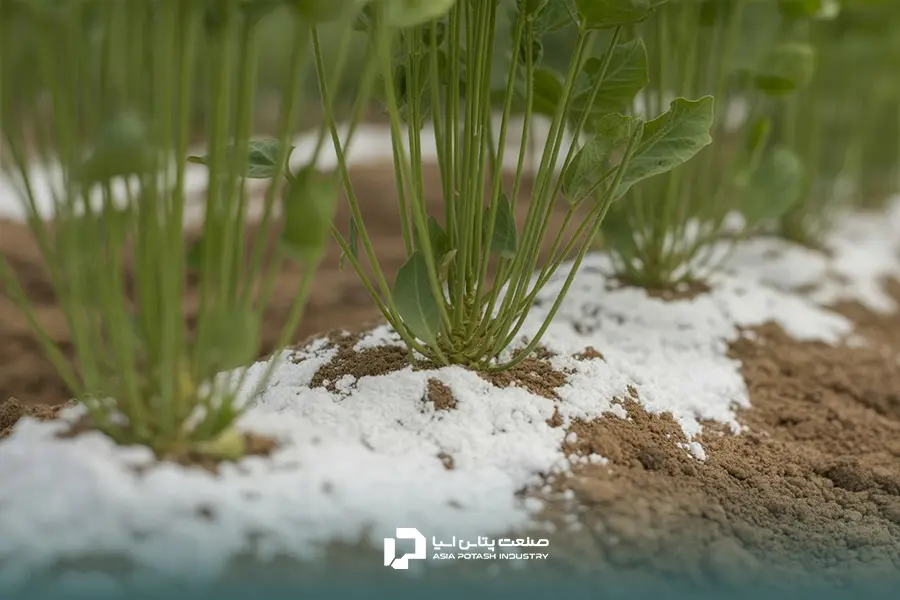
Stage 3: Vegetative growth and branching (canopy development)
From 6-leaf stage to flowering. The plant focuses on building biomass and canopy.
Nitrogen is the most important nutrient here but must be applied in split doses.
Recommended fertilizers:
- Nitrogen fertilizers (urea or ammonium sulfate): about 25% of total nitrogen requirement (e.g., 25 kg urea or 50 kg ammonium sulfate/ha).
- Balanced NPK (20-20-20): 10 kg/ha via fertigation.
- Foliar spray: NPK + micronutrients + seaweed extract or amino acids to improve photosynthesis.
Stage 4: Flowering and capsule formation (reproductive stage)
This is the most sensitive stage in sesame development. The goal is maximum flower retention and successful pollination.
Boron (B) and zinc (Zn) are critical.
Boron is essential for pollen tube growth; deficiency leads to empty capsules.
Recommended fertilizers:
- Boron and zinc fertilizers: foliar spray before peak flowering.
- High phosphorus fertilizer (10-52-10): 10 kg/ha via fertigation.
- Calcium fertilizers: foliar spray to strengthen cell walls and reduce flower drop.
Stage 5: Seed filling and maturation
This is the most economically important stage. Seeds act as strong sinks for nutrients.
Potassium is the key element for seed filling and oil synthesis.
Sulfur also plays a direct role in oil formation.
Recommended fertilizers:
High potassium fertilizers (Potassium Sulfate or solupotash): 30–50 kg/ha via fertigation in 2–3 applications and foliar spray (4–5 kg/ha twice).
High-potash NPK (e.g., 8-5-44): as supplement for potassium supply.
📌 More info:
Asia Potash Industry Potassium Sulfate fertilizer with high purity and very low chloride is an ideal choice. Contact us for distribution details.
Sales agency application is also available for partners.
Sesame fertilization schedule table
|
Growth stage |
Operation |
Fertilizer type |
Main goal |
|
Before planting |
Soil incorporation |
Manure / compost, superphosphate, Potassium Sulfate |
Soil improvement and baseline nutrition |
|
Germination |
Seed treatment & fertigation |
Biofertilizers, humic acid |
Root strengthening and establishment |
|
Vegetative growth |
Top dressing & foliar spray |
Ammonium sulfate/urea, NPK 20-20-20 |
Canopy development |
|
Flower initiation |
Foliar spray |
Boron (B) and Zinc (Zn) |
Increase flowering and reduce flower drop |
|
Seed filling |
Fertigation / foliar spray |
High potassium fertilizers (Potassium Sulfate) |
Increase seed weight and oil content |
Asia Potash Industry; your partner in improving sesame yield and quality
As emphasized in this article, potassium plays a key role in producing high-quality and profitable crops. It not only increases seed weight but also activates enzymes responsible for oil synthesis, directly improving economic value.
Asia Potash Industry produces high-purity Potassium Sulfate fertilizer designed for oilseed crops like sesame. This product:
- Has extremely low chloride content, preventing salinity or toxicity issues in sesame.
- Contains sulfur, which is essential for increasing oil percentage.
- Is highly soluble and suitable for fertigation and foliar application systems.
Choosing Asia Potash Industry Potassium Sulfate is a smart investment for maximizing your crop quality and yield.
What are the symptoms of potassium deficiency in plants?
Final words
Sesame fertilization is a science. By following a fertilization program based on soil and leaf testing and understanding the plant’s needs at each growth stage, you can unlock the full potential of your farm. A holistic approach combining organic, bio, and chemical fertilizers yields the best results.
We look forward to hearing your experiences and questions. Please share your comments below and send this article to others so they can benefit as well.
Comments (0)
Be the first to comment!