
Soybean is one of the important agricultural products in the world and in Iran, which, in addition to its high nutritional value, plays an important role in supplying vegetable oil and animal feed meal. Achieving optimal yield in soybean cultivation, in addition to selecting good seeds, requires a set of scientific and managerial practices so that the final product is at a desirable level in terms of both quantity and quality. One of the most important of these measures is having a precise approach to the soybean fertilization program tailored to soil and climate conditions.
In developing a complete soybean nutrition program, factors such as soil nutrient status, soil pH adjustment, rainfall levels, and even cropping history must be considered.
In this article from Asia Potash Industry Agriculture Magazine, we will take a look at soybean fertilization.
Basic Principles of Soybean Nutrition Program
Every successful fertilization program is based on specific scientific principles. In soybean nutrition, these points help farmers make maximum use of soil nutrients while achieving the highest profit at the lowest cost.
Fertilizer, Right Rate, Time, and Place (4R)
The well-known 4R principle means selecting the right nutrient source, using the correct rate, at the right time, and in the right place. This global principle is the foundation of many fertilization programs, especially in soybean.
For example, phosphorus is most effective during the early establishment stage of the plant, while potassium plays a more important role during seed filling. Ignoring any of these four factors can lead to fertilizer waste or reduced yield.
Soil Testing and Cropping History
No nutrition program is complete without understanding soil status. Soil testing is the best tool for identifying nutrient deficiencies and excesses.
The results of this test help the farmer determine which nutrient needs to be improved and which fertilizer should be prioritized. In addition, crop rotation is also important; for example, if corn was planted last year, the soil may be poorer in nitrogen, and this issue must be considered in the soybean nutrition program.
Soil Health and Organic Matter
Healthy soil is the foundation of sustainable agriculture. Organic matter in soil not only increases water retention capacity but also improves the activity of beneficial microorganisms.
In addition, soil with sufficient organic matter slowly and steadily supplies nutrients to the plant and prevents sharp fluctuations in nutrition.
Role of Soil pH in Soybean Fertilization
One of the most important factors in the success of soybean nutrition programs is soil pH adjustment. If pH is outside the optimal range, even with sufficient fertilizer application, the plant cannot properly absorb nutrients. Therefore, before starting any nutrition program, soil pH status must be checked and corrected if necessary.
Optimal Soil pH Range for Soybean
Soybean performs best in soil with a pH between 6 and 6.8. This range allows most nutrients to be available to the roots and enhances the activity of beneficial soil microorganisms. When pH is below 6, calcium and magnesium uptake is limited and toxicity from heavy metals such as aluminum may occur. If it is above 7, iron and manganese uptake is disrupted.
Effect of pH on Nitrogen, Phosphorus, and Manganese
Nitrogen fixation is much better in soils with proper pH, and roots form more nodules. In acidic soils, the plant requires more nitrogen fertilizer, and in alkaline soils, phosphorus and manganese uptake decreases significantly, showing deficiency symptoms such as leaf yellowing or reduced growth.
Proper Time for pH Correction and Liming
Soil acidity correction is usually done using agricultural lime. The best time for this is a few months before soybean planting so that lime has enough time to react in the soil. The required amount is determined based on soil test results, but the key point is that lime must be thoroughly mixed into the plow layer.
In contrast, in alkaline soils, amendments such as agricultural sulfur or bentonite sulfur should be used. These materials oxidize into sulfuric acid and gradually reduce pH, improving nutrient availability.
Importance of Phosphorus in Plant Growth and Root Development
Phosphorus is essential for soybean growth and plays the main role in strengthening roots and early plant establishment. It provides energy for cell division and growth of new tissues, helping roots expand faster in the soil.
Phosphorus deficiency leads to slow growth, weak plants, and reduced ability to absorb water and nutrients.
Phosphorus Application Rate Based on Soil Test
The required amount of phosphorus depends on soil status and test results. Generally, in phosphorus-deficient soils, 30 to 50 kg of pure phosphorus per hectare is recommended, while medium soils may require 20 to 30 kg per hectare.
Improving Plant Quality with Potassium
Potassium is a vital element for soybean that plays an important role in improving plant resistance and seed quality. It helps regulate stomatal opening and closing, movement of water and nutrients in the plant, and enzyme activity, enabling soybean to better withstand environmental stress, salinity, and diseases.
In addition, potassium has a direct effect on seed filling and thousand-seed weight, significantly improving final yield.

Role of Potassium in Plant Resistance and Seed Filling
Potassium allows the plant to maintain stable growth under fluctuations in moisture and temperature. Potassium deficiency is usually accompanied by leaf margin scorch, reduced growth, and light, incomplete seeds. Therefore, adequate potassium supply is essential for both plant health and product quality.
Timing of Potassium Fertilization in Soybean
For potassium fertilization, timing and application method are very important. In low-potassium soils, application before planting or in autumn is recommended for base fertilization and soil preparation. Spring application near active growth stages can also correct potential deficiencies.
Role of Sulfur, Calcium, and Magnesium in Soybean Fertilization
These elements each play an important role in soybean health and growth, and their deficiency can reduce yield and quality:
- Sulfur is essential for protein synthesis and plant tissue growth.
- Calcium helps strengthen cells and root development.
- Magnesium plays a key role in photosynthesis and energy production.
Effective Micronutrients in Soybean Growth and Quality
Micronutrients play a key role in soybean growth and, even in small amounts, can significantly affect yield and quality. These include manganese, zinc, boron, molybdenum, and iron, each with a specific function in the plant.
- Zinc: Important for cell division and flower and seed development. Its deficiency causes smaller leaves and reduced seed production.
- Manganese: An important element for enzymatic activity and photosynthesis; deficiency appears as interveinal yellowing in young leaves.
- Boron: Essential for flower formation and pod setting. Its deficiency can lead to flower drop and reduced yield.
- Molybdenum: Plays a role in nitrogen fixation by rhizobium bacteria. Its deficiency reduces nitrogen fixation and early plant growth.
- Iron: Essential for chlorophyll formation and photosynthesis; deficiency appears as yellowing of young leaves with green veins.
Best Fertilizers for Soybean Fertilization
Understanding types of agricultural fertilizers and selecting the right fertilizer for soybean is very important because proper supply of macro- and micronutrients leads to balanced growth, higher yield, and better seed quality. Depending on soil needs and climate conditions, appropriate phosphorus and potassium sources and micronutrient management are essential.
Phosphorus Fertilizers
Common phosphorus fertilizers include diammonium phosphate, triple superphosphate, and MAP, each with its own advantages:
- Diammonium phosphate contains both phosphorus and nitrogen and is useful for early plant growth.
- TSP has higher phosphorus concentration and is suitable for phosphorus-deficient soils.
- MAP contains phosphorus and some nitrogen and is suitable for mixing with other fertilizers.
Potassium Fertilizers
Common potassium sources include Potassium Chloride and Potassium Sulfate.
- Potassium Chloride dissolves easily in soil and is suitable for low-salinity soils.
- Potassium Sulfate provides both potassium and sulfur and is a good choice for sulfur-deficient soils and saline-sensitive crops.
Choosing Fertilizer Based on Soil and Climate
Fertilizer selection should be based on soil characteristics, nutrient levels, and climate conditions. Calcareous and sandy soils may require faster-acting fertilizers, while soils with high organic matter can better utilize slow-release fertilizers.
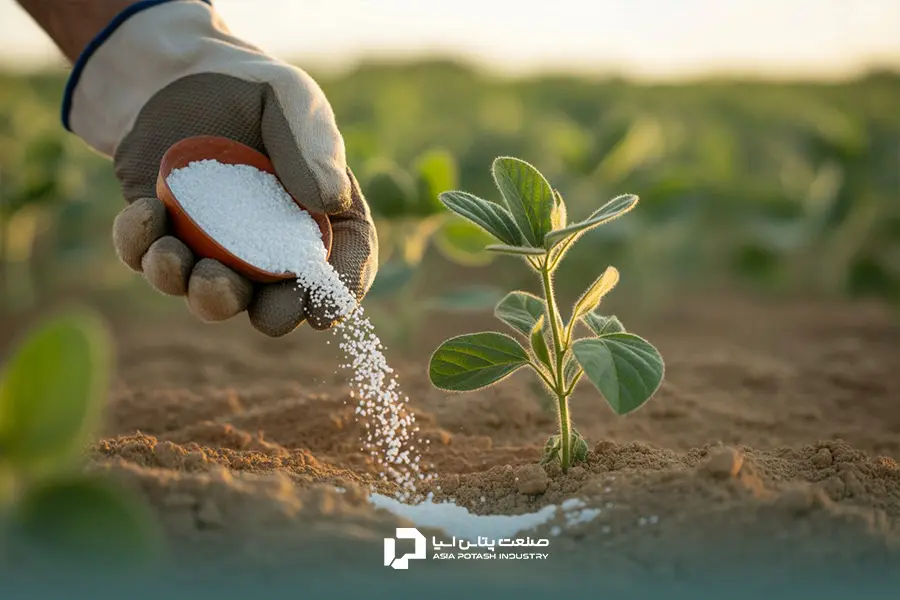
Complete Soybean Nutrition Program Based on Growth Stages
Proper soybean nutrition at different growth stages directly affects plant health, yield, and seed quality:
Before Planting
Before planting, soil correction with lime for pH adjustment and calcium/magnesium supply is essential. At the same time, phosphorus, potassium, and sulfur are applied based on soil test recommendations to ensure early plant nutrition.
From Planting to Two-Leaf Stage
During this stage, the main goal is early nutrition and support for rhizobium bacteria activity for nitrogen fixation. Starter fertilizers can be used, which are low-dose, highly available fertilizers placed near the seed.
Three to Five Leaf Stage
During this active vegetative stage, the need for micronutrients such as zinc, manganese, and boron increases. Plant growth should be monitored continuously, and deficiencies corrected if observed.
Flowering to Early Pod Formation
During flowering and pod formation, the plant requires sufficient potassium and sulfur. These elements are important for seed filling and plant strength, and iron deficiency should also be monitored.
Seed Filling to Full Maturity (R5 onwards)
In late growth stages, the main goal is maintaining healthy leaves and active green leaf area for seed filling. Excess fertilization without a proper plan can be ineffective and costly. Smart fertilizer use based on field needs is the most efficient approach.
Soybean Fertilization Program Table
|
Growth Stage |
Fertilizer Type |
Nutrition Goal |
|
Pre-planting |
Lime if acidic, phosphorus, potassium, sulfur |
Soil correction and base nutrient supply |
|
Planting to 2-leaf (V2) |
Starter phosphorus or low-dose potassium, rhizobium inoculation |
Improve establishment and early root growth |
|
3–5 leaf (V3–V5) |
Micronutrients like zinc, manganese, and boron |
Prevent deficiencies and maintain vegetative growth |
|
Early flowering (R1–R3) |
Potassium and sulfur management, foliar spray if needed |
Increase resistance and improve pod and seed formation |
|
Seed formation (R5) |
Foliar micronutrient spray |
Maintain leaf health and improve final seed quality |
Methods of Fertilizer Application in Soybean
Choosing the proper fertilizer application method depends on fertilizer type, soil conditions, and plant growth stage.
1. Broadcast application
In this method, fertilizer is spread on the soil surface and then mixed into the soil. It is simple and fast and suitable for slow-release fertilizers or well-drained soils. However, in low-phosphorus or low-potassium soils, nutrient uptake may be limited.
2. Band application
Banding means placing fertilizer beside the planting row or near the seed. This allows plants to access nutrients more quickly and efficiently.
3. Starter or in-row placement
Using starter fertilizers near the seed during early growth improves root development and accelerates plant growth.
This method ensures early nutrient availability and builds a strong foundation for later growth stages.
4. Foliar micronutrient application
For rapid correction of micronutrient deficiencies such as iron, zinc, or manganese, foliar spraying is effective. It is especially useful in calcareous soils where nutrient availability is limited.
Soil Monitoring and Nutritional Problems in Soybean
Regular monitoring of soil and plants helps farmers detect nutrient deficiencies early and correct them before yield is reduced. Pre-planting soil tests and in-season testing provide accurate information for better fertilizer management.
In addition, leaf analysis and visual symptom observation are important tools for diagnosing deficiencies. For example, interveinal yellowing may indicate manganese or iron deficiency, while burnt leaf edges often indicate potassium deficiency.
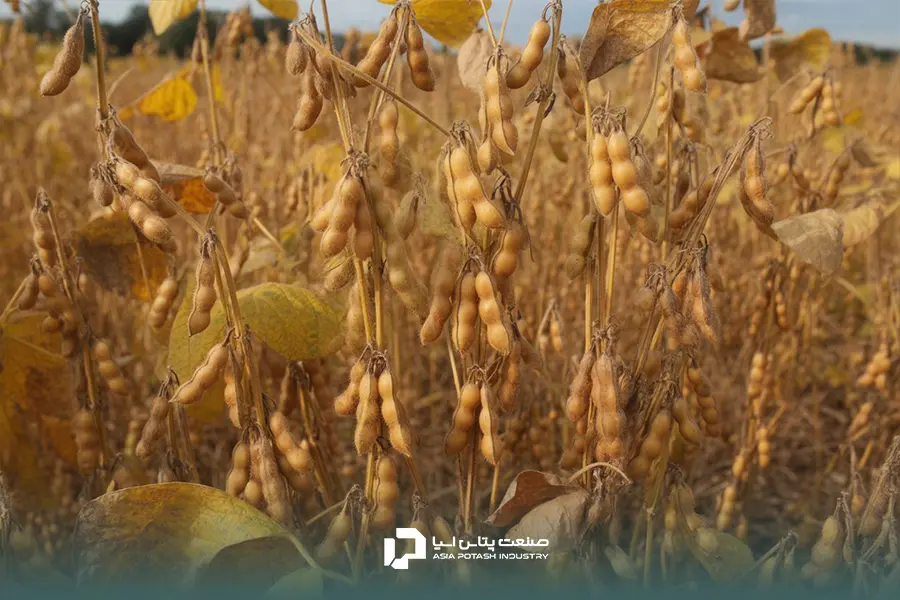
Soybean Fertilization Under Different Conditions
In specific soil and climate conditions, soybean nutrition management requires special attention:
1. No-till soils
In no-till fields, root access to nutrients is limited. Band placement or starter fertilizers help ensure adequate nutrition and strong root development.
2. Sandy soils
In sandy soils or soils with low cation exchange capacity, nutrients are easily leached.
In such conditions, slow-release fertilizers or split applications are recommended.
3. Calcareous soils
Calcareous soils reduce iron and micronutrient availability, leading to iron chlorosis.
Foliar iron application or use of bioavailable fertilizers helps prevent leaf yellowing.
4. Corn–soybean rotation
In rotation with corn, soils may lack certain nutrients, so soil testing and pre-plant correction are essential.
💡 Read More: Corn fertilization table and usage guide
Best Soybean Fertilization Products with Asia Potash Industry
To achieve the best soybean nutrition program and reduce ineffective costs, using specialized resources and precise consulting is essential.
Ensuring sufficient potassium supply for soybean is one of the key factors in improving yield and quality. Asia Potash Industry provides high-quality potassium fertilizers such as high-potash fertilizer, playing an important role in supplying this essential nutrient and helping farmers achieve healthy and high-yield crops.
Final Remarks
Proper soybean nutrition is the key to plant health, higher yield, and better seed quality. By following these points, the best results can be achieved:
- Soil and leaf testing to determine exact nutrient needs.
- Managing soil pH and proper use of lime and sulfur for better nutrient availability.
- Understanding the role of phosphorus and potassium in early growth and seed filling.
- Targeted supply of micronutrients, sulfur, calcium, and magnesium.
- Adapting fertilization programs to local soil and climate conditions to avoid nutrient waste.
Ultimately, the best results are achieved when nutrition programs are aligned with the specific characteristics of the soil and farm.
FAQ
Soybean can fix nitrogen through rhizobium bacteria and usually does not require additional nitrogen. However, in poor or newly prepared soils, limited nitrogen in early stages can improve root and plant growth.
In such soils, band or starter application of phosphorus and potassium fertilizers is recommended so that roots can access nutrients quickly and early plant growth is strengthened.
The best fertilizers for soybean include phosphate fertilizers, potassium fertilizers such as Potassium Chloride and Potassium Sulfate, and micronutrients like iron, manganese, and zinc. Selection should be based on soil testing and climate conditions.
Comments (0)
Be the first to comment!